Hello!Welcome to Shanghai Sheeny Metal Materials Co.,Ltd. Website!
Hotline:+86-400-6632276

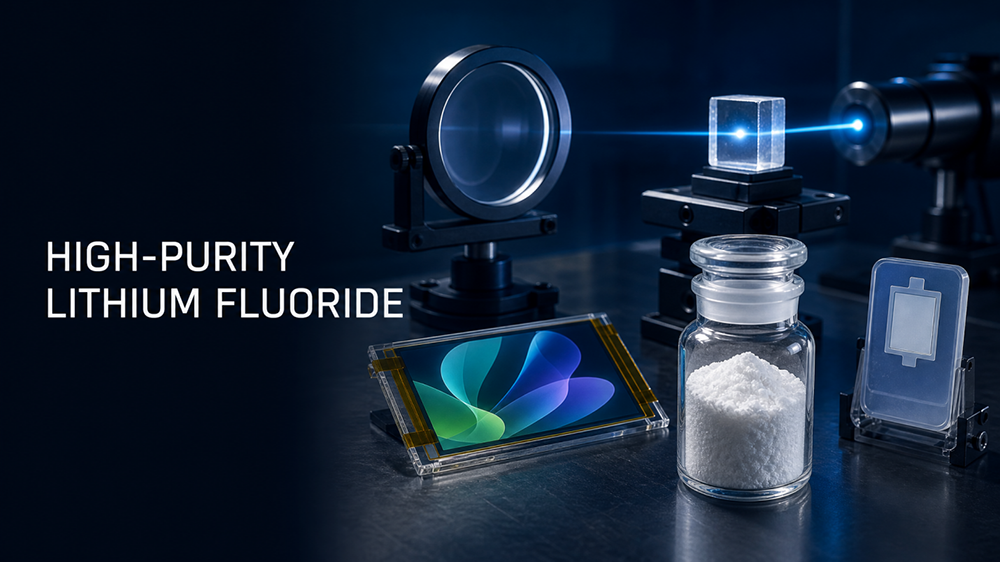
When lithium fluoride (LiF) is mentioned, lithium batteries are often the first application that comes to mind.
That association is understandable. Lithium fluoride is involved in the synthesis of lithium hexafluorophosphate, and LiF is also frequently observed in the solid-electrolyte interphase (SEI) layer formed inside batteries. However, battery-grade lithium fluoride is not necessarily suitable for every advanced application. Battery-grade LiF may require a purity of 99.95%, while some optical, electronic and radiation-related applications call for purity levels of 99.995% or higher.
High-purity lithium fluoride is used in applications such as vacuum-ultraviolet optical windows, laser crystals, OLED functional layers and thermoluminescent dosimeters. In these fields, trace impurities can introduce absorption in the ultraviolet range, create defects in crystals or interfere with electron injection at a device interface.
In other words, ordinary lithium fluoride and high-purity lithium fluoride may share the same chemical formula, but they do not necessarily serve the same markets.
Lithium is the lightest metal, and fluorine is the lightest halogen. Lithium fluoride combines these two elements in a relatively simple compound with several useful properties, including a very broad transmission range, a low refractive index and the ability to store radiation-related information in its crystal structure.
These characteristics make high-purity LiF relevant to optics, photonics, electronic devices and radiation measurement.
An optical window allows light to pass through while keeping an instrument isolated from its surrounding environment.
For example, a vacuum-ultraviolet spectrometer must maintain a vacuum because air absorbs part of the ultraviolet signal. If the light source is outside the vacuum chamber, the instrument needs a transparent interface through which the ultraviolet light can enter. That interface is the optical window.
Many conventional optical materials transmit poorly in the deep-ultraviolet range. Ordinary optical glass generally stops transmitting below 200 nm, while fused silica, a widely used ultraviolet optical material, has a cutoff near 160 nm. At shorter wavelengths, most materials absorb a significant portion of the incoming light.
A lithium fluoride single crystal, by contrast, can transmit down to approximately 104 nm, reaching into the vacuum-ultraviolet range. Because even oxygen in the air can absorb light in this region, high-quality LiF windows are essential for instruments that need to observe deep-ultraviolet radiation in a vacuum environment.
Transition-metal impurities in ordinary LiF can introduce additional absorption in the ultraviolet range. For this reason, vacuum-UV windows, prisms and related optical components require carefully controlled purity.
Typical applications include:
• Vacuum-ultraviolet spectrometers
• X-ray spectroscopy systems
• Synchrotron beamlines
• Deep-space and extreme-environment optical systems
• Excimer laser windows
Lithium fluoride hemispherical domes are also being explored for demanding optical interfaces. These components can cover a transmission range from approximately 110 nm to 6 micrometers and may be used in deep-space exploration, nuclear environments and excimer-laser systems. In 193 nm excimer lasers used for refractive eye surgery, the output window must withstand intense ultraviolet radiation while maintaining optical performance.
YLF lasers are solid-state laser systems based on lithium yttrium fluoride, or LiYF4. The crystal is commonly grown using the Czochralski method, with high-purity lithium fluoride and yttrium fluoride serving as raw materials.
The purity of LiF directly affects the optical quality of the finished crystal and its laser-damage performance. Transition-metal impurities such as iron, copper and nickel can form absorption centers in the YLF crystal. These centers introduce optical losses at laser wavelengths and may reduce the output efficiency of the laser system.
As a result, laser-crystal-grade lithium fluoride generally requires a purity of 4N or higher, depending on the crystal-growth process and the required device performance.
The downstream applications of YLF lasers include:
• Industrial laser processing
• Medical laser systems
• Scientific research lasers
• Precision optical instruments
From lithium fluoride powder to a YLF crystal and then to a finished laser system, high-purity LiF is the starting point of the materials chain.
Whenever light passes through glass, part of it is reflected at the surface. As the number of optical elements increases, reflection losses can reduce brightness and image quality.
One way to address this problem is to deposit a thin-film coating on the surface of the optical element. The coating is designed to reduce reflection through controlled interference. This process is known as optical coating.
Optical coatings can be engineered for:
• Antireflection
• High reflection
• Beam splitting
• Polarization control
• Infrared transmission
• Ultraviolet transmission
Metal fluorides are widely valued in optical coating systems because of their broad transmission ranges, low optical absorption, stable physical and chemical properties and compatibility with vacuum thermal evaporation.
Lithium fluoride has a refractive index of approximately 1.39, placing it among the lowest-refractive-index solid materials commonly used in optical design. This makes it useful in antireflection coating structures.
If the lithium fluoride is not pure enough, impurities in the coating can introduce absorption and reduce transmission. In industrial systems, LiF-based coatings may also be considered for high-laser-damage-threshold optical windows used with CO2 lasers and ultrafast laser systems.
These coatings can be found on optical components used in laser cutting machines, laser welding equipment and medical lasers. They are usually invisible in the finished equipment, but they can have a direct influence on the efficiency and reliability of the optical path.
OLED displays generate light when electrons and holes recombine in organic semiconductor layers. However, injecting electrons from a metal electrode into an organic layer is not always efficient. The interface between the electrode and the organic material creates an energy barrier.
A very thin lithium fluoride layer can be inserted between the electrode and the organic layer to improve electron injection.
In OLED manufacturing, lithium fluoride is used as an evaporation material rather than being added as a bulk powder. Research comparing different LiF thicknesses has reported that an OLED device without a LiF layer had a turn-on voltage of 10 V and a luminous efficiency of 2.58 cd/A. With a 2 nm LiF layer, the turn-on voltage decreased to 7 V, while brightness reached 1,345 cd/m2 and luminous efficiency increased to 4.4 cd/A.
The end products include:
• OLED smartphone displays
• OLED televisions
• VR headset displays
The LiF layer may be less than 2 nm thick, but it can help electrons cross the interface between the metal electrode and the organic semiconductor in every pixel.
Workers in radiology departments, nuclear power plants and radiotherapy centers often wear personal dosimeters. One widely used thermoluminescent material is lithium fluoride doped with magnesium, copper and phosphorus, commonly written as LiF:Mg,Cu,P.
The operating principle is thermoluminescence. After the lithium fluoride crystal is exposed to radiation, part of the absorbed energy becomes stored in defects within the crystal lattice. When the material is heated, the stored energy is released as light. The intensity of that light is related to the absorbed radiation dose.
By measuring the emitted light, a monitoring system can estimate the radiation dose received by a worker or an object.
Lithium-fluoride-based thermoluminescent dosimeters are used in areas such as:
• Nuclear power facilities
• Nuclear-submarine radiation monitoring
• Personal dose monitoring
• Environmental radiation monitoring
• Occupational health and radiation protection
Shanghai Sheeny Metal Materials Co., Ltd. supplies high-purity lithium fluoride with a stated purity of at least 99.995%. According to the GDMS test data cited in the original article, the LiF purity reaches 99.9987%, with total impurities of approximately 13 ppm.
The same data reports that several transition metals relevant to optical absorption and electronic-device performance are controlled at sub-ppm levels: iron at 0.6 ppm, titanium at 0.07 ppm, nickel at 0.03 ppm and copper below 0.1 ppm. Thorium and uranium are each reported below 0.01 ppm.
For applications that require strict control of optical absorption, interface defects or radiation background, impurity data is an important part of material qualification. A GDMS report can help buyers evaluate whether a high-purity LiF product is suitable for ultraviolet optical windows, OLED evaporation materials, thermoluminescent dosimeters or laser-crystal production.
High-purity lithium fluoride is not limited to the battery-materials market. Its optical transmission, low refractive index, crystal behavior and electronic-interface properties connect it to a wider range of advanced applications.
Shanghai Sheeny Metal Materials Co., Ltd. supplies high-purity lithium fluoride (LiF) in grades above 4N, with bulk supply and GDMS test reports available with shipments. The material can be evaluated for vacuum-UV optical windows, OLED evaporation materials, thermoluminescent dosimetry and laser-crystal raw materials.
For product specifications, purity requirements and application discussions, contact:
• Hotline: 400-663-2276
• WeChat: 16602150044
• Email: sales@eternal-element.com
• Website: www.eternal-element.cn
Before publication, confirm the cited purity, test data, optical transmission range and application-specific performance against the latest product specification sheets and third-party test reports.
#LithiumFluoride #HighPurityMaterials #AdvancedMaterials #VacuumUV #LaserCrystals #OLED #RadiationDosimetry #OpticalCoatings #MaterialsScience #Photonics

Room 310, Building 1, No. 326, Jinyuan Third Road, Jiading District, Shanghai
Tel : +86-400-6632276
Mobile&Whatsapp : +86 19916550170
Email : sales@eternal-element.com
Scan to wechat :


