Hello!Welcome to Shanghai Sheeny Metal Materials Co.,Ltd. Website!
Hotline:+86-400-6632276

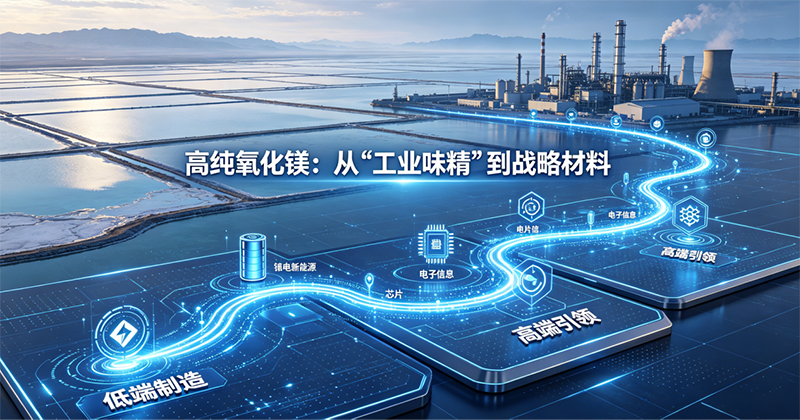
As new energy, electronic information, and high-end manufacturing industries surge forward, high-purity magnesium oxide (MgO) has become a critical foundational material for high-end industrial chains. Known as “industrial MSG” for its high purity, high activity, and heat resistance, China has achieved multiple breakthroughs in high-purity MgO production in recent years, leveraging its resource advantages and technological efforts. The country is now accelerating the replacement of foreign monopolies and driving the industry toward higher purity, greener processes, and customized solutions.
Current Industry Landscape: Soaring Demand Meets Upgrading Supply
High-purity magnesium oxide generally refers to products with MgO purity ≥99.0%. Based on purity levels, it can be classified into 99-grade, 99.5-grade, 99.9-grade, and ultra-high purity 4N (99.99%) and above. For premium products, total impurities such as iron, silicon, and calcium must be controlled below 100 ppm, while electronic-grade materials require individual impurities to be under 10 ppm.
Market demand for high-purity MgO continues to grow globally. The market size is expected to exceed US$2.5 billion by 2025, with China contributing over 40%. Domestically, China produced approximately 128,000 tons of high-purity MgO in 2023, of which 38.7% were premium products (purity ≥99.9%) – a 12.3 percentage point increase from 2020. The demand structure is also evolving: traditional refractory applications dropped from 68% in 2019 to 52% in 2025, while emerging sectors such as lithium battery separator coatings, electronic ceramics, and semiconductor packaging are growing at over 12% CAGR, becoming the core growth engines.
On the supply side, China holds the world’s largest magnesium oxide production capacity (over 55% of global share). However, it has long faced a structural imbalance of “low-end surplus, high-end scarcity.” Ordinary-grade products (purity <97%) account for more than 85%, leading to intense homogenized competition. Ultra-high purity products (≥99.9%) still rely heavily on imports, with import prices 3–5 times higher than ordinary products. Nevertheless, thanks to technological breakthroughs, domestic substitution is accelerating – the localization rate is expected to approach 40% for the first time in 2025.
Technological Breakthroughs: Diversified Processes Optimize Purity and Cost
The production process for high-purity magnesium oxide is at the core of industrial development. Current mainstream technologies include chemical precipitation, hydrothermal synthesis, carbonation, and salt lake magnesium extraction – each suited to different raw materials and purity requirements.
Chemical precipitation: Using brine or magnesium sulfate as raw materials, followed by carbonation and calcination. This mature, cost-effective process accounts for 65% of domestic capacity, mainly producing 98–99.5-grade products. Traditional precipitation faced impurity control challenges, but Chinese enterprises have adopted “multi-stage dynamic calcination” and “fully enclosed automated production” to stabilize purity above 99.5%, with heavy metal residues below 5 ppm.
Carbonation: Using dolomite or magnesite as raw materials through calcination, digestion, carbonation, pyrolysis, and recalcination, achieving MgO purity up to 99.56%. Low raw material cost makes it suitable for large-scale production. Teams from Northeastern University and Xi’an Jiaotong University have further improved purity and activity by optimizing reaction parameters.
Salt lake magnesium extraction: Leveraging Qinghai’s salt lake resources, using bischofite (a byproduct of lithium extraction from salt lakes) as raw material. The world-first cobalt-specific active magnesium oxide process achieves 99.0% purity with low consumption and high recovery. It has been successfully applied in tailings recovery for copper-cobalt mines in Africa, breaking foreign monopolies. This process enables high-value utilization of salt lake resources and aligns with the “dual carbon” goals.
Hydrothermal synthesis & sol-gel: These methods precisely control crystal morphology and particle size under high-temperature/high-pressure or colloidal reaction conditions, suitable for producing nano-sized, ultra-high purity MgO (≥99.99%). They are mainly used in high-end applications such as electronic ceramics and semiconductors.
Policy and Market Drivers: A Golden Era for Domestic Substitution
On the policy front, the 14th Five-Year Plan for Raw Materials Industry Development and the Catalog of Key New Materials for First Application Demonstration have listed high-purity magnesium oxide as a critical strategic material. The Ministry of Industry and Information Technology (MIIT) requires that the self-sufficiency rate of key basic materials reach over 75% by 2025. Meanwhile, the “dual carbon” policy is forcing the phase-out of outdated capacity and promoting green, low-carbon process innovations. Technologies such as ion exchange impurity removal, microwave-assisted crystallization, and continuous fluidized calcination have become R&D priorities.
On the market front, some Chinese companies have already sent semiconductor-grade samples for validation. From 2026 to 2030, China’s high-purity MgO market is projected to grow from RMB 2.8 billion (2025) to over RMB 6.5 billion, representing an 18.3% CAGR. The share of 99.99% grade products is expected to rise from 15% to over 35%.
Future Trends: Ultra-High Purity, Green Processes, and Customization
Three major trends will shape the future of the high-purity magnesium oxide industry:
Purity escalation – Moving toward 5N (99.999%) ultra-high purity products to meet extreme demands in semiconductors and nuclear industries.
Green and low-carbon – Low-energy, low-emission processes will become mainstream, with total energy consumption per ton expected to drop by another 15% or more.
Customized development – Developing application-specific products for different downstream sectors, such as lithium battery separators, electronic ceramics, and pharmaceutical/food-grade high-purity MgO, thereby increasing product value.
From “bottleneck” to self-sufficiency, from low-end manufacturing to high-end leadership, China’s high-purity magnesium oxide industry is entering a “golden decade.” With continuous technological breakthroughs and an improving industrial chain, domestically produced high-purity MgO will secure a more significant position in the global market, laying a solid material foundation for China’s high-quality development in new energy, high-end manufacturing, and beyond.
Shanghai Sheeny Metal Materials specializes in the R&D and production of high-purity magnesium oxide, with purity ranging from 99.99% to 99.999%, serving high-end manufacturing fields such as transparent ceramics, scintillation crystals, and piezoelectric crystals.

Room 310, Building 1, No. 326, Jinyuan Third Road, Jiading District, Shanghai
Tel : +86-400-6632276
Mobile&Whatsapp : +86 19916550170
Email : sales@eternal-element.com
Scan to wechat :


