Hello!Welcome to Shanghai Sheeny Metal Materials Co.,Ltd. Website!
Hotline:+86-400-6632276

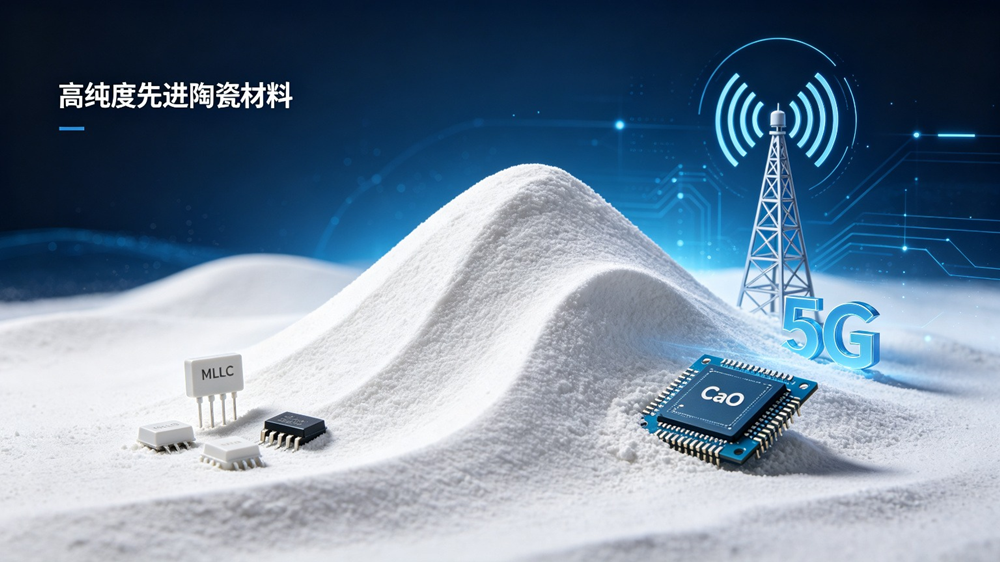
In our previous article, we explained how 5N ultra-high-purity calcium oxide (CaO) plays a decisive role in crystal growth and optical coating by “cutting off impurities at the source.” When transition-metal impurities such as Fe, Cu and Co are compressed to below 10 ppm, CaO transforms from industrial lime into the purity cornerstone of high-end manufacturing.
But the story does not end there. If crystals and optics are the “direct applications” of CaO — where calcium enters the lattice or film layer directly — then in the fields we discuss today, calcium plays a far more sophisticated role. It is no longer a simple additive to be doped in; it becomes the structural backbone of an entire ceramic system, an electrical-performance regulator, and even the last line of defense under extreme conditions.
This is advanced ceramics — a high-end battlefield where the volume of 5N CaO used is small, yet the material is indispensable: “without it, nothing works.”
You have probably seen an MLCC (multilayer ceramic capacitor) — an electronic component smaller than a grain of rice, hidden inside every smartphone, every car, and every 5G base station. At its core lies a stack of alternating ceramic dielectric layers and metal electrodes.
The mainstream dielectric material for MLCC is barium titanate (BaTiO₃). In high-end BME-MLCC (base-metal-electrode multilayer ceramic capacitors), the Ni electrodes must be co-fired in a reducing atmosphere to prevent oxidation. But this creates a problem: the reducing atmosphere generates oxygen vacancies in BaTiO₃, causing the ceramic to become semiconducting — the dielectric loses its insulating property and the capacitor fails.
This is exactly where calcium comes in. As an acceptor dopant, Ca²⁺ enters the BaTiO₃ lattice and captures oxygen vacancies, suppressing electronic conduction and preventing the insulation resistance from degrading — safeguarding the long-term reliability of MLCCs in service. A 2024 review in Acta Physico-Chimica Sinica (original title: “Reliability Mechanisms of the Ultrathin-Layered BaTiO₃ Based BME-MLCC”) points out that improving the reliability of ultra-thin-layered MLCCs requires lowering the oxygen-vacancy concentration in the ceramic dielectric and raising its activation energy. Rare-earth doping can help to a certain extent, while the synergistic doping of alkaline-earth ions such as Ca²⁺ and Mg²⁺ further optimizes the reduction resistance and long-term stability of BME-MLCC.
The key lies in the purity of the calcium source. Trace Fe, Na and K impurities introduced by industrial-grade calcium sources are themselves sources of oxygen vacancies — it is like patching one leak while poking a new hole. Although the acceptor-doping role of Ca²⁺ could theoretically be partially replaced by other alkaline-earth ions such as Mg²⁺, the core value of 5N (99.999%) high-purity calcium oxide is this: it supplies calcium ions while keeping harmful impurities at levels too low to form new defects. This dual capability — “supplying calcium without attracting dust” — is the true moat of high-purity CaO in high-end MLCC manufacturing.
Like MLCC, BaTiO₃-based PTC (positive temperature coefficient) thermistors exhibit a sharp increase in resistance by several orders of magnitude once the Curie temperature is reached — a characteristic that makes them core components in overcurrent protection, temperature sensing and degaussing circuits.
Here, calcium is not the main ingredient but a “grain refiner.” Research published in the Journal of the European Ceramic Society (Affleck & Leach, 2005) shows that Ca, as an A-site dopant entering the (Ba,Ca)TiO₃ lattice, primarily refines the grain structure. The smaller ionic radius of Ca²⁺ suppresses abnormal grain growth during sintering, making grain boundaries more uniform and predictable, thereby improving the stability and repeatability of the PTC effect. Another study from the same journal (2000) further demonstrated that PTC-BaTiO₃ ceramics with Ca additives maintain stable operation at service temperatures above 45°C.
This is another story of “impurities equal defects.” Trace transition metals introduced by industrial-grade calcium sources become uncontrolled acceptor states in PTC ceramics, directly affecting grain-boundary barrier height and causing resistance-temperature curves to drift. The significance of 5N purity is exactly the same as in the MLCC scenario — not that calcium itself is irreplaceable, but that the ability to “supply calcium without introducing new impurities” carries real value for batch-to-batch consistency in high-end thermistors.
If MLCC is calcium’s “micro-doping” application, then calcium titanate (CaTiO₃) is a material where calcium takes center stage.
CaTiO₃ is a typical perovskite-structure microwave dielectric ceramic with a relatively high dielectric constant (εᵣ ≈ 170) and good temperature stability. In 5G/6G communication systems, microwave dielectric ceramics are widely used in resonators, filters and antenna substrates — components that determine whether signals are “sieved clean” and whether frequency bands remain stable.
A 2023 study from the University of Leeds (“A high-performance, temperature-stable Mg₁.₉₉Ga₀.₀₁Si₀.₉₉Al₀.₀₁O₄-CaTiO₃ microwave dielectric ceramic and its 5G/6G waveguide filter”) showed that CaTiO₃-based composite ceramics exhibit excellent microwave dielectric properties in 5G/6G waveguide filters, with great industrialization potential. In similar systems, MgTiO₃-CaTiO₃ materials have also been studied for 5G communication components such as antenna substrates and resonators.
But the dielectric performance of CaTiO₃ is extremely sensitive to raw-material purity. The conventional route to synthesize CaTiO₃ is the solid-state reaction method — reacting CaO (or CaCO₃) with TiO₂ at high temperature. If residual SiO₂, Al₂O₃ and other impurities in the calcium source segregate at grain boundaries, secondary phases form, causing the dielectric loss (tan δ) to spike and the temperature coefficient to drift. For a 5G filter handling dozens of signal channels, a deviation in the dielectric constant of even one ceramic piece can send an entire channel “off course.”
If CaTiO₃’s dielectric constant is about 170, then CaCu₃Ti₄O₁₂ (CCTO) can reach 10⁴–10⁵ — a “giant dielectric” level among ceramic materials.
A 2020 study in ACS Applied Materials & Interfaces (“Excellent Capacitor–Varistor Properties in Lead-Free CaCu₃Ti₄O₁₂ Dielectrics”) identified CCTO as a highly promising lead-free perovskite dielectric candidate with dual capacitor–varistor functionality, particularly well suited to the trend of miniaturization in electronic devices.
However, CCTO imposes extremely stringent demands on raw-material purity. Synthesizing CCTO requires three precursors — CaO, CuO and TiO₂ — and transition-metal impurities in the calcium source (especially Fe) undergo complex redox reactions with CuO during sintering, altering the charge barriers at grain boundaries and causing the extrinsic giant-dielectric behavior to run out of control. In other words: with an impure calcium source, the CCTO you produce may show impressive data in the lab, but it will never achieve stable mass production.
Shanghai Sheeny Metal Materials Co., Ltd. leverages a combined purification process of chemical precipitation and solvent extraction to continuously supply 99.999% (5N) ultra-high-purity calcium oxide for advanced ceramics, MLCC, microwave dielectric ceramics and other electronic-component applications. The purity advantage is written into the test report.
Third-party GDMS testing (ISO 17025 certified) shows: Fe 1.6 ppm, Al 3.2 ppm, Si 2.0 ppm, with total detected metal impurities of approximately 15 ppm — corresponding to an absolute purity of ≥99.998%. Transition metals such as Co, Ti and Li are below the detection limit.
The scenarios that fear impurities the most are precisely where impurities are the fewest. For MLCC, the transition metals that “catalyze” oxygen vacancies — Fe, Co, Ni, Cu — are barely detectable. For microwave dielectric ceramics, Si and Al measure only 2.0 and 3.2 ppm, so no non-dielectric secondary phases form at grain boundaries and 5G channels never “run off course.” With impurities compressed from the percentage level to about 15 ppm, unexpected defects in solid-state reactions are reduced by three orders of magnitude, and batch consistency is locked in from the raw-material end.
Under a 50,000× electron microscope, the particles are fine and uniformly distributed, providing microscopic assurance of sintering uniformity.
Purity is not an adjective — it is a set of verifiable numbers.
Hashtags: #HighPurityCalciumOxide #99.999CaO #AdvancedCeramics #MLCC #BME #PTC #MicrowaveDielectric #5G #6G #CCTO #CalciumTitanate #UltraHighPurity #ElectronicMaterials #SheenyMetal

Room 310, Building 1, No. 326, Jinyuan Third Road, Jiading District, Shanghai
Tel : +86-400-6632276
Mobile&Whatsapp : +86 19916550170
Email : sales@eternal-element.com
Scan to wechat :


