Hello!Welcome to Shanghai Sheeny Metal Materials Co.,Ltd. Website!
Hotline:+86-400-6632276

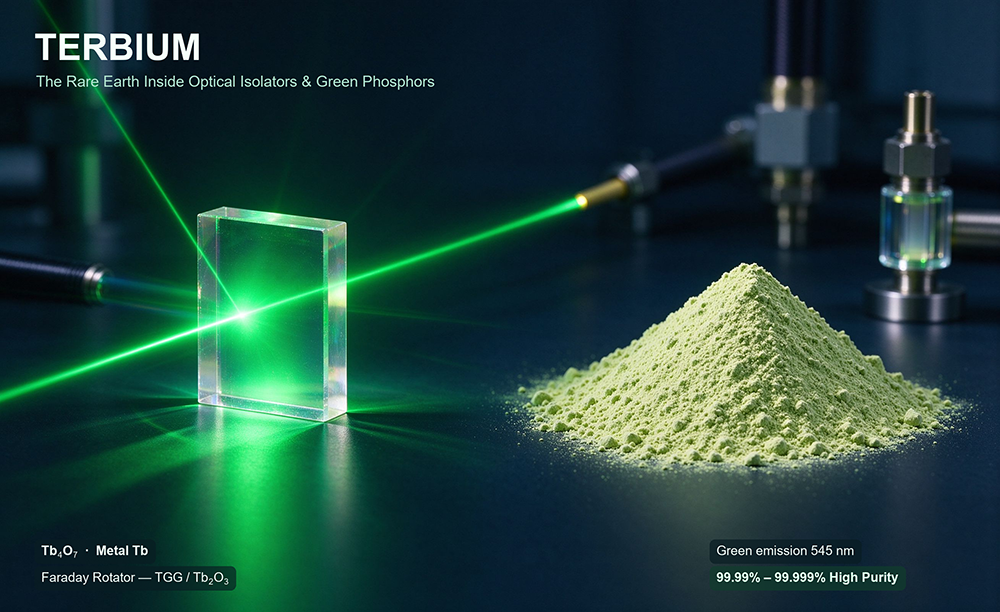
You may never have heard of terbium, but you have almost certainly seen its light: the green glow of fluorescent lamps, X-ray intensifying screens in hospitals and LCD backlights all come from the same rare-earth element.
Within the rare-earth family, terbium stands out in two directions. One is light: it emits the green wavelength to which the human eye is most sensitive. The other is magnetism: it helps high-end magnets resist thermal demagnetisation.
When excited, the terbium ion Tb3+ emits a characteristic green peak near 545 nm. That wavelength is fixed by Tb3+'s internal electronic structure — it does not drift, and the green it produces is pure and colour-accurate. The human eye is naturally most sensitive to green: the photopic response peaks around 555 nm, very close to 545 nm. At the same brightness, green looks the brightest, which is why display performance collapses when the green phosphor is impure or unstable.
This dependence has a long history. Ever since trichromatic fluorescent lamps, terbium has been the indispensable activator of green phosphors — the mainstream green phosphor LaPO4:Ce,Tb is still in use today: terbium emits the light while cerium hands the energy over to terbium. X-ray intensifying screens and medical imaging detectors are another long-standing stronghold: the Gd2O2S:Tb scintillator family converts X-rays passing through the body into green light, which a photodetector then reads as an image. Security checks, industrial CT and medical imaging all rely on this X-ray → light → electron chain.
Today, as display technology moves toward Micro-LED and wide colour gamuts, the demand for a narrower green emission band is actually growing: Tb3+-doped narrow-band green phosphors (for example silicate hosts) are a research hotspot, and a narrower emission bandwidth means higher colour-gamut coverage. Note that the mainstream route for Micro-LED colour conversion today is still Eu2+-activated inorganic phosphors and quantum dots; terbium narrow-band green phosphors remain mostly in research and custom development. But the very pursuit of "a narrower, purer green" shows terbium's value: across generations of lighting and display devices, terbium's green spectral line has been there at every step.
The magneto-optical effect — the Faraday effect — means that when light passes through certain magnetic materials, its polarisation plane rotates. Rotated one way by the magnetic field, light reflected back along the same path is rotated again in the same direction, doubling the total angle, and is then simply blocked by a polariser. This "lets light in, never lets it back" capability is essential in optical communications and laser systems: high-power fibre lasers use optical isolators to block reflected light. Even 0.1% back-reflected light is enough to disturb the gain medium.
The classic commercial magneto-optical material is TGG (terbium gallium garnet, Tb3Ga5O12) single crystals, widely used in optical isolators and circulators and usually grown by the Czochralski method. Tb2O3 — terbium kept fully in the trivalent state — rotates the polarisation plane even more strongly: its Verdet constant (the key figure of merit for the magneto-optical effect, i.e. how far a unit magnetic field rotates the polarisation plane) is about 3× that of TGG. Reported Tb2O3 transparent ceramics reach −427.3 rad·T−1·m−1 at 633 nm. The same isolation can therefore be achieved in a smaller device.
However, Tb2O3 melts at 2340 °C, turns brownish to Tb4O7 in hot oxidising air, and undergoes a phase transition near 1600 °C — large single crystals have remained at the millimetre scale. By doping small amounts of lutetium and yttrium to stabilise the lattice, then densifying the green body by hot isostatic pressing into transparent ceramics, in-line transmittance at 1400 nm has reached 79.4%. These ceramics are widely regarded as the most promising candidate for next-generation high-power Faraday isolators. Lithium terbium fluoride (LTF) crystals are another route targeting magneto-optical devices for high-power laser systems.
In optical communications and laser systems, terbium's ability to "control light" is irreplaceable.
Terbium oxide is also widely used in special ceramics and functional oxide systems. Doped into ceramic lattices, it imparts unique magnetic or optical functions. Terbium aluminium garnet (TAG) transparent magneto-optical ceramics, for example, are tape-cast (or dry-pressed) into green bodies, then cold isostatically pressed, sintered to density at high temperature, and polished — combining high transmittance with a high Verdet constant. Y2O3-stabilised terbium oxide magneto-optical ceramics follow a similar route. In optical-functional ceramic research, Tb3+ also acts as a luminescent centre for energy-level engineering. In high-end functional ceramics, terbium oxide is often the ingredient that "adds a trace, and changes everything".
If terbium oxide's home ground is light, metal terbium's home ground is magnetism.
NdFeB is today's strongest commercial permanent magnet material, but it is heat-sensitive: at high temperatures its magnetic performance drops, and in severe cases it suffers irreversible demagnetisation that cooling cannot restore. The answer: add terbium, or add dysprosium.
When terbium or dysprosium enters the Nd2Fe14B magnetic main phase and replaces part of the neodymium, it raises the magnetocrystalline anisotropy — making the magnetisation direction harder to "twist", and thus resisting high-temperature demagnetisation. How strong is the effect? Adding terbium can raise coercivity (a magnet's resistance to demagnetisation by heat and reverse fields) by more than 30%. This is exactly what traction motors in new-energy vehicles, wind turbines and robot joints need under high-temperature, strong-demagnetisation conditions: robot-joint motors are small and heat-concentrated, and whether the magnet holds directly determines the joint's power density and service life.
But more terbium is not always better: too much bulk substitution reduces remanence. Grain-boundary diffusion technology — using magnetron sputtering or TbH2 coating — concentrates terbium in the grain boundaries and grain surfaces, raising demagnetisation resistance with far less material. This is exactly the value of high-purity metal terbium sputtering targets. Sheeny Metal's metal terbium controls 60 elements (including gas elements C, N, O, S), with total impurities held between 10 and 1000 ppm.
If NdFeB is the "king of permanent magnets", Terfenol-D is the "king of giant magnetostriction".
Magnetostriction means a material deforms by itself under a magnetic field — give it a magnet, and it moves. ordinary magnetostrictive materials deform very little, but Terfenol-D — an alloy of terbium, dysprosium and iron in a specific ratio, roughly Tb0.27Dy0.73Fe1.95 — has a room-temperature saturated magnetostriction around 2000 ppm: a 1-metre rod extends about 2 mm when magnetised, roughly 40× that of traditional nickel-based magnetostrictive alloys. To put this number in perspective: piezoelectric ceramics strain by about 0.1% in an electric field — the same order of magnitude. Terfenol-D's real advantage is that it needs no electric field, drives without contact, responds fast and offers high energy density.
What can such large deformation do?
· Sonar systems: Terfenol-D was originally developed by the US Naval Research Laboratory for sonar, and remains a core transducer material.
· Precision actuators: fast response, high energy density and contactless drive suit precision machinery and adaptive control systems.
· Sensors: high sensitivity and reliability for vibration monitoring and position sensing.
· SoundBug: Terfenol-D's first commercial application — a device that sticks to glass and turns the whole pane into a speaker.
Producing Terfenol-D also requires high-purity metal terbium, and impurity control directly governs the alloy's magnetostrictive performance and service reliability.
Whether terbium oxide or metal terbium, purity is not a label — it is a physical fact that acts at every processing step:
· In phosphors and scintillators, a single Fe, Cu or Co impurity ion can "eat" the luminescence energy of many surrounding Tb ions.
· In magneto-optical ceramics, impurities add optical loss and lower transmittance.
· In NdFeB, impurities lodge at grain boundaries, disturb magnetic domains and directly reduce coercivity.
· In Terfenol-D, impurities lower the magnetostriction coefficient and degrade response speed and fatigue life.
This is why high-end applications push terbium purity upward layer by layer — from 3N (99.9%) to 4N (99.99%) and on to 5N (99.999%). Each additional "9" represents a huge leap in separation and purification technology. The value of terbium comes not just from having it, but from having it pure.
Shanghai Sheeny Metal Materials Co., Ltd. supplies high-purity terbium oxide (Tb4O7) and metal terbium (Tb) for optoelectronic displays, magneto-optical materials, high-performance permanent magnets and giant magnetostrictive alloys. Using a combined chemical-precipitation and solvent-extraction purification process, key impurities are controlled at the ppm level — with sensitive elements down to the ppb level — and batch-to-batch variation is tightly controlled.
Product | Grade | Typical downstream applications |
Terbium oxide Tb4O7 | 99.99% | Phosphors, scintillation ceramics |
Terbium oxide Tb4O7 | 99.999% | TGG / TSAG crystal growth, magneto-optical ceramics |
Metal terbium Tb | 99.9% / 99.99% | NdFeB addition, Terfenol-D, sputtering targets |
If you are evaluating magneto-optical crystal raw materials, luminescent / scintillation materials, or permanent-magnet alloying routes, contact Sheeny Metal to discuss your requirements.
Shanghai Sheeny Metal Materials Co., Ltd. (Sheeny Metal) is a Chinese manufacturer of high-purity rare earth oxides and inorganic materials, supplying the optoelectronics, magneto-optics, advanced ceramics and permanent-magnet industries with ppm-level impurity-controlled products.
1. Blasse G, Grabmaier B C. Luminescent Materials. Berlin: Springer-Verlag, 1994.
2. van Eijk C W E. Inorganic scintillators for medical imaging. Phys. Med. Biol., 2002, 47: R85–R106.
3. Zvezdin A K, Kotov V A. Modern Magnetooptics and Magnetooptical Materials. Bristol: IOP Publishing, 1997.
4. Hu D, Li X, Zhang L, et al. Terbium (III) oxide transparent ceramics by two-step sintering from precipitated powder. Magnetochemistry, 2022, 8: 73.
5. Hono K, Sepehri-Amin H. Strategy for high-coercivity Nd–Fe–B magnets. Scr. Mater., 2012, 67: 530–535.
6. Clark A E. Magnetostrictive rare earth-Fe2 compounds. In: Ferromagnetic Materials, Vol. 1. Amsterdam: North-Holland, 1980.

Room 310, Building 1, No. 326, Jinyuan Third Road, Jiading District, Shanghai
Tel : +86-400-6632276
Mobile&Whatsapp : +86 19916550170
Email : sales@eternal-element.com
Scan to wechat :


