Hello!Welcome to Shanghai Sheeny Metal Materials Co.,Ltd. Website!
Hotline:+86-400-6632276

META DESCRIPTION
99.999% high-purity calcium oxide (5N CaO) in CaZrO3 crucibles, hydrogen sensors, transparent spinel ceramics and red phosphors — where impurity control decides performance.
KEYWORDS
high purity calcium oxide, 99.999% CaO, 5N calcium oxide, CaZrO3 crucible, titanium alloy melting, proton conductor, hydrogen sensor, solid oxide fuel cell, transparent spinel ceramics, transparent optical window, CaTiO3:Pr3+ red phosphor, sintering aid, rare earth oxide
In Part I, we examined the critical roles of 5N calcium oxide in advanced electronic ceramics such as MLCCs, PTC thermistors and 5G microwave dielectric ceramics — where calcium ions act as a trace-dopant "precision finisher" or as the primary lattice-building element.
But the stage for calcium extends far beyond those applications. When the temperature soars to 1500°C and melts become active enough to corrode almost every container; when protons must be conducted precisely through high-temperature hydrogen-rich atmospheres — in these extreme environments, calcium-based functional oxides stand as the irreplaceable "last line of defense." Beyond furnaces and sensors, the same purity logic continues to hold in luminescent materials and transparent ceramics.
CaZrO₃ Crucibles: The "Non-Stick Pot" for Melting Titanium Alloys
How demanding are titanium alloys? With high specific strength, excellent corrosion resistance and good biocompatibility, they are star materials in aerospace, marine engineering and biomedical applications. But at the melting stage, titanium’s chemical activity becomes notoriously troublesome — at high temperatures it reacts with almost every crucible material. Al₂O₃ crucibles? Reaction. ZrO₂ crucibles? Deoxidation. Graphite crucibles? Carburization.
Calcium zirconate (CaZrO₃) solves this problem. CaZrO₃ has a perovskite structure and exhibits outstanding chemical inertness toward titanium alloy melts at high temperatures, maintaining high corrosion resistance even at extreme temperatures up to 1800°C. A 2023 study in the Journal of the European Ceramic Society evaluated CaZrO₃ as a highly promising crucible material for titanium alloy melting and identified an "upgraded" solution: introducing Ba into CaZrO₃ to form a (Ba₀.₈Ca₀.₂)ZrO₃ solid solution reduced the crucible’s erosion layer by approximately 85%–92.5% compared with pure CaZrO₃, with a clear interface and virtually no elemental diffusion — like an extra layer of "body armor" for the crucible.
And it all starts with a high-purity calcium source. CaZrO₃ is synthesized from CaCO₃ (or CaO) and ZrO₂ by solid-state reaction; impurities in the raw material remain at grain boundaries and become preferential reaction sites at high temperatures. More critically, titanium is extremely sensitive to oxygen content — a single ppb-level Fe impurity can leave irreversible contamination in a titanium alloy ingot worth millions.
Calcium Zirconate: From Hydrogen Sensors to Solid Oxide Fuel Cells
CaZrO₃ has a second identity: a proton conductor — a special material that allows hydrogen ions (protons) to "pass through in an orderly queue" through the solid.
Commercial application — the "hydrogen sentinel" in molten aluminum: In-doped CaZrO₃ exhibits good proton conductivity in high-temperature hydrogen-containing atmospheres (approximately 1.3×10⁻⁸ S/cm) and has been commercially applied in hydrogen sensors for molten aluminum, enabling real-time detection of hydrogen content in molten metal.
Performance leap — a more sensitive "hydrogen detector": Sc-doped CaZrO₃ (CaZr₀.₉Sc₀.₁O₂.₉₅) shows higher conductivity. In 2023, researchers designed an amperometric sensor based on CaZr₀.₉₅Sc₀.₀₅O₃₋δ that detects hydrogen concentration in air at 600–700°C, with a sensitivity of up to about 60 μA/1% H₂, fast response and good repeatability. In-doped CaZrO₃ has also been used in tritium monitoring sensors for nuclear applications.
Frontier breakthrough — letting protons "travel" at room temperature: A 2024 study published in Nature Communications found that Y-doped CaZrO₃ (CaZr₀.₈Y₀.₂O₃₋δ) exhibits OH⁻ ion conduction in water, with an ionic conductivity of up to about 0.1 S/cm in 6 M KOH solution at 90°C — 100 times higher than in pure water — opening new possibilities for low-temperature fuel cells and electrolyzers.
Impurity-induced extrinsic defects disrupt the "dedicated channels" for proton hopping transport. The purity of the calcium source determines just how unobstructed those channels remain.
Transparent Ceramics: CaO, the "Optical Finisher" of Spinel
Transparent spinel ceramics (MgAl₂O₄) are key materials for transparent armor, infrared windows and radomes.
They combine the hardness and impact resistance of ceramics with optical transmittance approaching that of glass, making them irreplaceable in armored-vehicle viewports, infrared seeker radomes and high-pressure sodium lamp envelopes.
CaO plays a subtle but decisive role here — as a sintering aid, added at levels as low as a few hundred ppm, yet directly determining the optical quality of the ceramic. A study in the Journal of the European Ceramic Society (Effect of CaO on the optical quality and microstructure of transparent MgO·1.5Al₂O₃ spinel ceramics) systematically investigated the influence of CaO on the optical quality of transparent spinel. Adding an appropriate amount of CaO suppresses abnormal grain growth during sintering, making grain boundaries more uniform, reducing light scattering at grain boundaries and improving transmittance. However, if the CaO dosage is inappropriate or the purity of the calcium source is insufficient, second phases can instead form at grain boundaries — and any grain-boundary second phase causes light scattering, lowers transmittance, and makes "transparent ceramics" no longer transparent.
Here lies a detail that is easily overlooked: as a sintering aid, CaO is added at only a few hundred ppm. The smaller the amount, the more "inescapable" the impurities carried in by the calcium source itself — they are not diluted like the main component, but are directly enriched at grain boundaries, becoming scattering centers. This is precisely where "sintering-aid-grade 5N CaO" earns its place: CaO must promote sintering without becoming an impurity "transporter."
CaTiO₃:Pr³⁺: The Red Luminescence Code That Lights Up Screens
CaTiO₃ was a microwave dielectric in Part I, but it has another identity — a luminescent host.
When doped with Pr³⁺, CaTiO₃ becomes a red long-afterglow phosphor, studied for field emission displays (FEDs), solid-state lighting and fluorescence thermometry. A 2011 study in the Journal of the American Ceramic Society showed that the color purity of CaTiO₃:Pr³⁺ phosphor can be enhanced to 92.1%; a 2017 study in ACS Omega explicitly pointed out that luminescence properties are positively correlated with the phase purity of the oxide host.
The worst enemy of phosphors is impurity quenching — transition metal impurities such as Fe, Cu and Co act as "quenching centers" that dissipate the energy meant for light emission as heat. The purity of the calcium source directly determines emission intensity and color purity.
Sheeny Metal 99.999% CaO: The Final Gate
Looking back at these scenarios, a common pattern emerges: most calcium-based materials are prepared by solid-state reactions — calcium oxide mixed with other metal oxides, followed by high-temperature calcination and sintering. Throughout this process, impurities in the calcium source are not "burned away"; they embed directly into the material matrix, becoming permanent lattice defects or grain-boundary second phases.
"The defects of precision ceramics begin with the raw materials." This is why 5N-grade (99.999%) high-purity calcium oxide has evolved from an "option" into a "necessity" — once impurities are irreversibly embedded in the lattice or remain at grain boundaries, the performance of the material can never be recovered.
From 1500°C titanium alloy melts, to 600°C hydrogen-rich atmospheres, to 90°C alkaline electrolytes, and on to the red light on screens and the transparent windows on armor — calcium-based materials do the same thing in every scenario: keep impurities out, and keep function in the lattice.
In extreme environments, the cost of impurity is magnified a hundredfold — which is why our confidence is written in test reports. Third-party GDMS analysis shows: Fe 1.6 ppm, Al 3.2 ppm, Si 2.0 ppm, with a total of about 15 ppm detected metallic impurities, corresponding to an absolute purity of ≥99.998%; transition metals such as Co, Ti and Li are below detection limits, and radioactive elements Th and U are below ppb levels.
The 1500°C furnace is the most unforgiving examination for impurities. A single ppb-level Fe is enough to leave irreversible oxygen contamination in a titanium alloy ingot — Shanghai Sheeny Metal’s 5N-grade calcium oxide: Fe measured at 1.6 ppm, with Co and Ti undetectable. Compressing total impurities from percentage levels to about 15 ppm means three orders of magnitude fewer accidental defects entering the lattice during solid-state reactions — every material function is locked in from the raw-material stage. Under 50,000× electron microscopy, the particles are fine and uniformly distributed — uniform powder is the first guarantee of orderly grain boundaries and controllable defects.
Ultimate purity is the true confidence under extreme conditions.
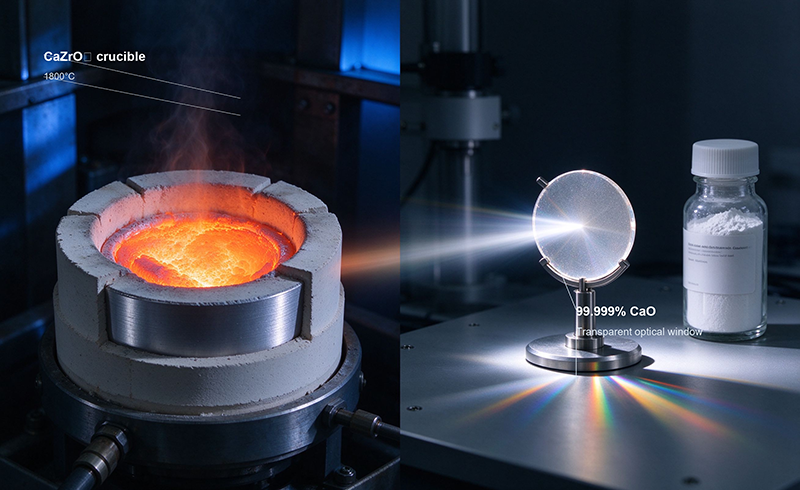
Figure: 99.999% high-purity calcium oxide in extreme applications — a CaZrO₃ crucible at 1800°C (left) and a transparent optical window (right).
About Shanghai Sheeny Metal Materials Co., Ltd.
Shanghai Sheeny Metal Materials Co., Ltd. specializes in the R&D and production of 99.999% high-purity rare earth oxides and advanced inorganic materials, including high-purity calcium oxide for advanced ceramics, MLCC, transparent ceramics and optical applications.
Website: www.eternal-element.cn | Tel: +86-400-663-2276
References
[1] A novel potential ceramic material for melting Ti₆Al₄V alloy: A solid solution of BaZrO₃ and CaZrO₃, Journal of the European Ceramic Society, 2023, 43: 6571-6580.
[2] Solid-Oxide Amperometric Sensor for Hydrogen Detection in Air, ChemEngineering, 2023, 7(3): 45.
[3] Zou P, Iuga D, Ling S, et al. A fast ceramic mixed OH⁻/H⁺ ionic conductor for low temperature fuel cells, Nature Communications, 2024.
[4] Enhancement of Photoluminescence and Color Purity of CaTiO₃:Pr³⁺ Red Phosphor, Journal of the American Ceramic Society, 2011.
[5] Sol–Gel Synthesis of CaTiO₃:Pr³⁺ Red Phosphors, ACS Omega, 2017.
[6] Effect of CaO on the optical quality and microstructure of transparent MgO·1.5Al₂O₃ spinel ceramics prepared by reactive sintering, Journal of the European Ceramic Society, 2018.

Room 310, Building 1, No. 326, Jinyuan Third Road, Jiading District, Shanghai
Tel : +86-400-6632276
Mobile&Whatsapp : +86 19916550170
Email : sales@eternal-element.com
Scan to wechat :


