Hello!Welcome to Shanghai Sheeny Metal Materials Co.,Ltd. Website!
Hotline:+86-400-6632276

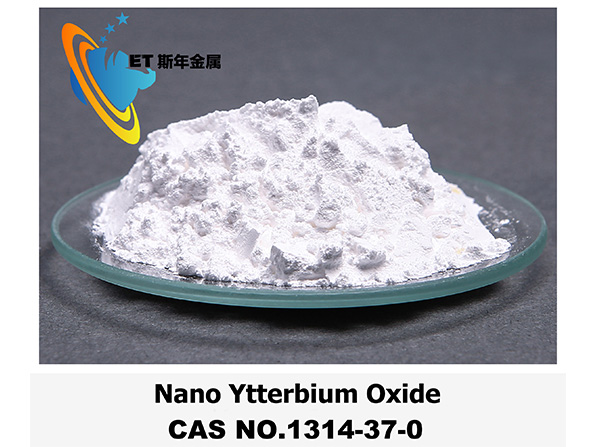
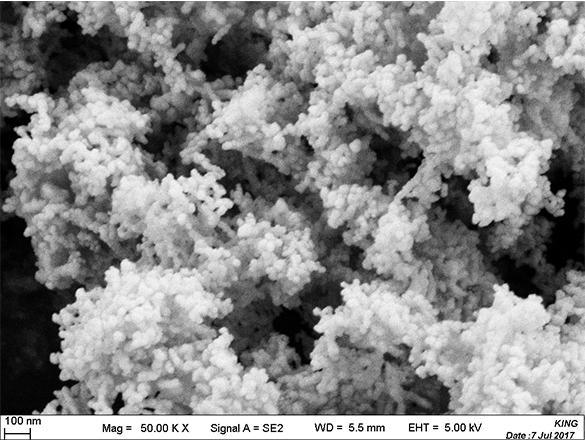
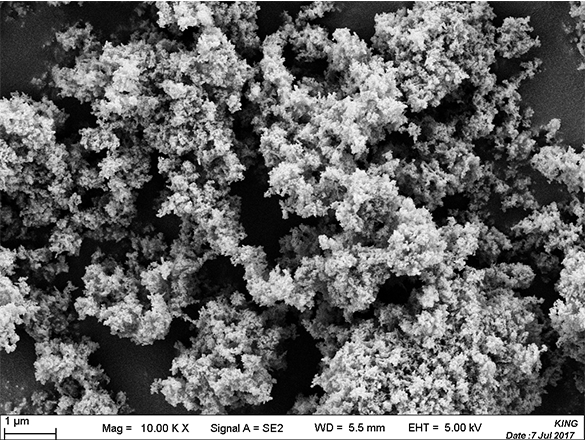
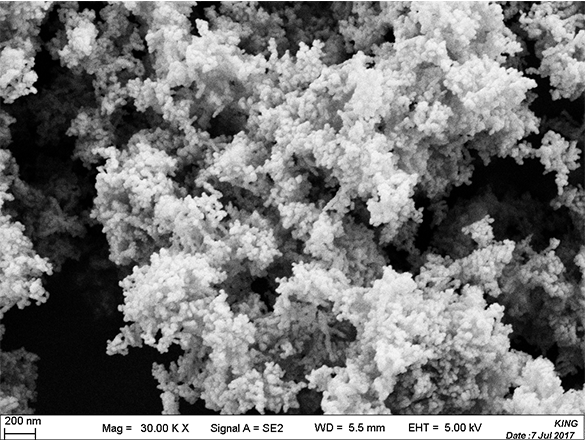
CAS #: 1314-37-0
Molecular Formula: Yb2O3
EC No.: 215-234-0


Nanometer ytterbium oxide is a white to pale yellow powder with a melting point of approximately 2350°C and a density of about 7.17 g/cm³. As a heavy rare earth oxide, it is paramagnetic at room temperature. Its crystal structure is cubic (C-type). Nanometer ytterbium oxide is insoluble in water but soluble in strong inorganic acids. It possesses unique optical properties; the Yb³⁺ ion has sharp absorption and emission peaks in the near-infrared region (around 980 nm) and high quantum efficiency. It is also an excellent upconversion luminescence host material. Given the high reactivity of its nanoparticles, it is recommended to store sealed in a dry, dark environment to prevent deactivation through reaction with atmospheric moisture and carbon dioxide.
Applications:
1. Optical Fiber Communication & Lasers: Serves as the core gain medium for high-power ytterbium-doped fiber lasers and amplifiers, characterized by high conversion efficiency, low thermal effects, and high output power.
2. Infrared Stealth & Sensing: Utilizes its strong near-infrared absorption characteristics for infrared stealth coating materials for military equipment; also used in manufacturing high-temperature stress and temperature sensors.
3. Stainless Steel Industry: Acts as a trace additive for high-performance stainless steels and alloys, effectively refining grains and improving material strength, toughness, and corrosion resistance.
4. Upconversion Luminescence: Serves as a matrix for upconversion luminescent materials, absorbing infrared light and emitting visible light, applied in bioimaging, anti-counterfeiting, and solar cells.
5. Catalysis: Functions as an efficient catalyst for organic synthesis reactions (e.g., olefin polymerization, aldol condensation), offering high selectivity and reactivity.
6. Radioactive Medicine: The Yb-169 isotope can serve as a radioactive source for portable X-ray machines, used in industrial non-destructive testing and medical diagnostics.
7. Ceramics & Glass: Acts as a sintering aid for special ceramics, lowering the sintering temperature; imparts near-infrared absorption properties to glass for manufacturing protective eyewear.
8. Thermoelectric Materials: Serves as a filler for thermoelectric materials like skutterudites, effectively reducing lattice thermal conductivity and improving thermoelectric conversion efficiency.
Product | Product Code | Security Data | Technical Data |
Nano Ytterbium Oxide 99.995% | ET-Yb-NM |
Linear Formula | Yb₂O₃ |
CAS Number | 1314-37-0 |
Molecular Weight | 394.08 |
EC Number | 215-234-0 |
Appearance | White to pale yellow powder |
Assay | ≥99.7% trace metals basis |
Form | nanopowder |
BET(m2 /g) | 20.13m2/g , BET |
SEM(nm) | <100(99%) |
Density | 7.17 g/cm³ |
MDL Number | MFCD00011290 |
UNSPSC Code | 12352302 |
PubChem Substance ID | 24882845 |
NACRES | NA.23 |
Reaction Suitability | reagent type: catalyst |
SMILES String | O=[Yb]O[Yb]=O |
InChI | 1S/3O.2Yb |
InChI Key | FIXNOXLJNSSSLJ-UHFFFAOYSA-N |
| Nano Ytterbium Oxide |

Nanometer ytterbium oxide is a white to pale yellow powder with a melting point of approximately 2350°C and a density of about 7.17 g/cm³. As a heavy rare earth oxide, it is paramagnetic at room temperature. Its crystal structure is cubic (C-type). Nanometer ytterbium oxide is insoluble in water but soluble in strong inorganic acids. It possesses unique optical properties; the Yb³⁺ ion has sharp absorption and emission peaks in the near-infrared region (around 980 nm) and high quantum efficiency. It is also an excellent upconversion luminescence host material. Given the high reactivity of its nanoparticles, it is recommended to store sealed in a dry, dark environment to prevent deactivation through reaction with atmospheric moisture and carbon dioxide. |

Room 310, Building 1, No. 326, Jinyuan Third Road, Jiading District, Shanghai
Tel : +86-400-6632276
Mobile&Whatsapp : +86 19916550170
Email : sales@eternal-element.com
Scan to wechat :


