Hello!Welcome to Shanghai Sheeny Metal Materials Co.,Ltd. Website!
Hotline:+86-400-6632276

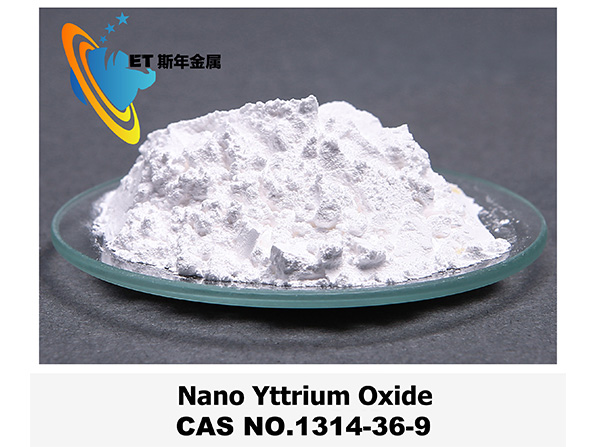
CAS #: 1314-36-9
Molecular Formula: Y2O3
EC No.: 215-233-5


Nanometer yttrium oxide is a white fine powder with a high melting point of approximately 2410°C and a density of about 3.01 g/cm³. As an important rare earth oxide, it exhibits excellent chemical and thermal stability at room temperature. Its crystal structure is cubic phase. Nanometer yttrium oxide is insoluble in water and alkalis but soluble in dilute acids. It possesses a high thermal neutron absorption cross-section and outstanding luminescent matrix properties, enabling it to act as a host material for activating various rare earth luminescent ions. Given the high specific surface area and tendency for agglomeration of its nanoparticles, it is recommended to store sealed in a dry environment to maintain its dispersibility and physicochemical properties.
Applications:
1. Structural Ceramics: Serves as a key stabilizer for zirconia ceramics, significantly enhancing their fracture toughness and thermal shock resistance, widely used in cutting tools, wear-resistant components, and artificial joints.
2. Luminescence and Displays: Functions as the core matrix material for red phosphors (e.g., Y₂O₃:Eu³⁺), used in CRT displays, fluorescent lamps, and LED devices.
3. High-Temperature Protective Coatings: Used as the ceramic topcoat material for thermal barrier coatings, applied alongside a bond coat on aircraft engine turbine blades, providing excellent high-temperature insulation and corrosion resistance.
4. Electronic Ceramics: Employed in manufacturing microwave dielectric ceramics, semiconductor thin films, and high-dielectric-constant capacitors, meeting the demands of high-frequency circuits and integrated electronic components.
5. Glass Industry: Used as an additive for special optical glass, increasing the refractive index, heat resistance, and chemical stability of glass, applied in camera lenses and laser devices.
6. Catalysis: Acts as a catalyst or catalyst support in automotive exhaust purification, petroleum cracking, and synthetic rubber processes.
7. Medical Biology: Used as a bioceramic composite material for dental and orthopedic repairs; its luminescent properties are also applied in biological labeling and imaging.
8. Nuclear Industry: Utilizes its high thermal neutron absorption cross-section for manufacturing control rods and neutron-absorbing materials in nuclear reactors
Product | Product Code | Security Data | Technical Data |
Nano Ytterbium Oxide 99.995% | ET-Yb-NM |
Molecular Formula | Y₂O₃ |
CAS # | 1314-36-9 |
Molecular Weight | 225.81 |
EC Number | 215-233-5 |
Appearance | Solid |
Form | nanopowder |
Quality Level | 100 |
BET(m2 /g) | 24.85 m²/g,BET |
SEM(nm) | 30-70 |
Melting Point (mp) | 2410 °C |
Density | 3.01 g/cm³ |
MDL Number | MFCD00011473 |
UNSPSC Code | 12352302 |
PubChem Substance ID | 24878792 |
NACRES | NA.23 |
Greener Alternative Characteristics | Design for Energy Efficiency |
Sustainability | Greener Alternative Product |
Greener Alternative Category | Enabling |
SMILES String | O=[Y]O[Y]=O |
InChI | 1S/3O.2Y |
InChI Key | SIWVEOZUMHYXCS-UHFFFAOYSA-N |
| Nano Yttrium Oxide |

Nanometer yttrium oxide is a white fine powder with a high melting point of approximately 2410°C and a density of about 3.01 g/cm³. As an important rare earth oxide, it exhibits excellent chemical and thermal stability at room temperature. Its crystal structure is cubic phase. Nanometer yttrium oxide is insoluble in water and alkalis but soluble in dilute acids. It possesses a high thermal neutron absorption cross-section and outstanding luminescent matrix properties, enabling it to act as a host material for activating various rare earth luminescent ions. Given the high specific surface area and tendency for agglomeration of its nanoparticles, it is recommended to store sealed in a dry environment to maintain its dispersibility and physicochemical properties. |

Room 310, Building 1, No. 326, Jinyuan Third Road, Jiading District, Shanghai
Tel : +86-400-6632276
Mobile&Whatsapp : +86 19916550170
Email : sales@eternal-element.com
Scan to wechat :


