Hello!Welcome to Shanghai Sheeny Metal Materials Co.,Ltd. Website!
Hotline:+86-400-6632276

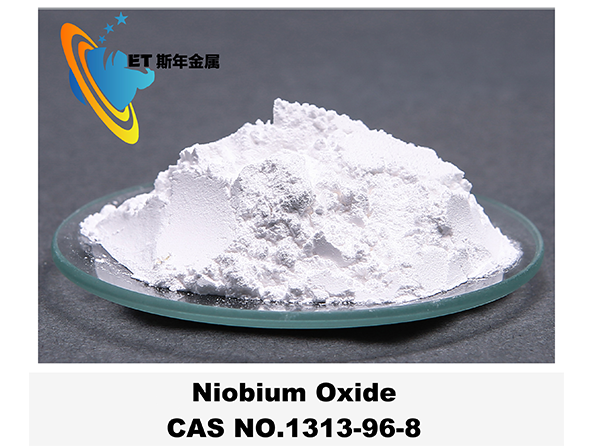
CAS #: 1313-96-8
Molecular Formula: Nb2O5
EC No.: 215-213-6


Niobium oxide is an inorganic compound with the chemical formula Nb2O5, a molecular weight of 265.81, a white crystal, a melting point of 1460℃, a relative density of 4.47, a relative dielectric constant of 35-50, and a band gap of 3.4eV. When heated to 400℃, it turns yellow. It is soluble in hydrofluoric acid, hot sulfuric acid and alkali, but insoluble in water. It is the most stable oxide. The chemical formula of its hydrate is Nb2O5· xH2O. It decomposes when heated and is soluble in concentrated sulfuric acid, concentrated hydrochloric acid, hydrofluoric acid and strong alkali, but insoluble in water and ammonia water. It can be obtained by burning metallic niobium in air or by dehydrating niobic acid.
Applications:
It is used for making high-temperature alloys and superconducting alloys.
2. It is used for making optical glass.
3. It is used for making capacitors in the electronics industry [piezoelectric, thermosensitive, electrothermal ceramics, etc.].
4. It is used for making coating materials.
| Product | Product Code | Security Data | Technical Data |
| Niobium Oxide 99% | ET-Nb-01 | ||
| Niobium Oxide 99.9% | ET-Nb-02 | ||
Niobium Oxide 99.99% | ET-Nb-03 | |
| Molecular Formula | Nb2O5 |
| Molecular Weight | 265.81 |
| Appearance | Powder |
| Melting Point | 1512°C (2754°F) |
| Boiling Point | N/A |
| Density | 4.47 g/cm3 |
| Precise Quality | 265.787329 |
| Single Isotope Mass | 265.787329 |
| Signal Word | Warning |
| Risk Statement | H315-H319-H335 |
| Dangerous Code | Xi |
| Preventive Instructions | P261-P305 + P351 + P338 |
| Flash Point | N/A |
| Risk Code | 36/37/38 |
| Safety Statement | 26-36 |
| RTECS Number | QU0500000 |
| Transportation Information | NONH |
| WGK Germany | nwg |
| GHS Pictogram |  |
Packaging Specifications:
Standard packaging: 50 kg/drum, 500 kg/pallet, ton bags
Sample packaging: 500 g/bag, 1 kg/bottle
| Niobium Oxide |

The calcination method involves dissolving niobium material or crude niobium pentoxide in a mixture of nitric acid and hydrofluoric acid to form fluorobium acid. Then, niobium is extracted using a mixture of strong acid and the organic phase of methyl isobutanone. After stripping, ammonia water and fluorobium acid react to form niobium hydroxide precipitate. After washing, drying and calcination, refined niobium pentoxide can be obtained. 3Nb+5HNO3+21HF→3H2NbF7+5NO+10H2OH2NbF7+7NH4OH→Nb(OH)5+7NH4F+2H2O2Nb(OH)5→2Nb(OH)5+5H2O Niobium pentoxide is mainly used in industries such as ceramics, electronic ceramics, optical glass, glass coating, liquid crystal displays, and energy. In recent years, with the rapid development of industries such as glass coating and liquid crystal displays, the demand for niobium pentoxide targets, especially high-quality niobium pentoxide targets, has been increasing. Under normal circumstances, for high-quality target materials, the first requirement is to have a high density (>99.5%) and a high purity (>99.99%). Second, it is required to have a good microscopic phase structure, that is, the particle size of the target material crystal is at the micrometer level and evenly distributed at the microscopic level. In addition, the niobium pentoxide target material also needs to have good mechanical properties. |

Room 310, Building 1, No. 326, Jinyuan Third Road, Jiading District, Shanghai
Tel : +86-400-6632276
Mobile&Whatsapp : +86 19916550170
Email : sales@eternal-element.com
Scan to wechat :


