Hello!Welcome to Shanghai Sheeny Metal Materials Co.,Ltd. Website!
Hotline:+86-400-6632276

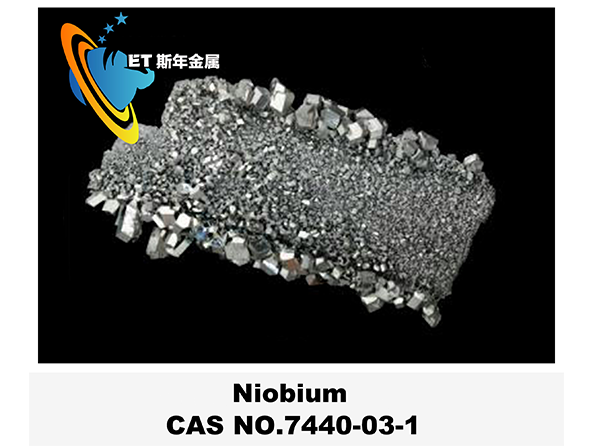
CAS # : 7440-03-1
Molecular Formula: Nb
EC No.: 231-113-5


The molecular formula of metallic niobium is Nb, with an atomic number of 41. It belongs to the VB group of the periodic table and has valences of 2, 3, 4, and 5. There are no stable isotopes. There are 49 isotopes of niobium, ranging from Nb-81 to Nb-113. Except for niobium-93, which is stable and constitutes the natural existence of all elements in the Earth's crust, all elements are radioactive and artificially produced. Niobium is a soft gray-silver metal, similar to freshly cut steel. It is usually found in minerals together with other related metals. Due to the thin niobium oxide coating, it will not change color at room temperature or oxidize in the air. However, it is prone to oxidation at high temperatures (above 200°C), especially by oxygen and halogens (Group 17). When combined with tin and aluminum alloys, niobium exhibits superconductivity at 9.25 Kelvin.
Applications:
1.It is used for making high-temperature alloys and superconducting alloys.
2. It is used for making coating materials or sputtering targets.
Product | Product Code | Security Data | Technical Data |
Metallic Niobium 99.9% | ET-NbM-01 | ||
Metallic Niobium 99.95% | ET-NbM-02 |
Molecular Weight | 92.9 |
Appearance | Silvery |
Melting Point | 2477℃ |
Boiling Point | 4744℃ |
Density | 8.57 g/cm3 |
Resistivity | 152Ω·m (0 °C) |
Electronegativity | 1.6 Paulings |
Heat of Vaporization | 689.9 kJ/mol |
Poisson's Ratio | 0.4 |
Specific Heat | 0.27 kJ/kg·K |
Tensile Strength | N/A |
Thermal Conductivity | 5.37 W/m ·K |
Thermal Expansion | 7.3 µm/(m·K) |
Vickers Hardness | 1320 MPa |
Young's Modulus | 105 GPa |
Signal word | N/A |
Disclaimer | N/A |
Dangerous Code | N/A |
Preventive Instructions | N/A |
Flash Point | N/A |
Risk Code | N/A |
Safety Statement | N/A |
RTECS Number | N/A |
Transportation Information | NONH |
WGK Germany | NONH |
Packaging Specifications:
Standard packaging: 50 kg/drum, 500 kg/pallet, ton bags
Sample packaging: 500 g/bag, 1 kg/bottle
| Niobium |

There are several methods for extracting and refining niobium from ores. The chosen method depends on the nature of the ore and the final use of the metal. Some common steps in these recycling processes include ore pre-concentration, crushing or opening the ore to obtain pure niobium compounds, reducing niobium compounds to niobium metal, purifying or refining the metal, and manufacturing. If niobium is extracted from niobium-tantalum ores, the most important step is to separate niobium from tantalum, as the two are chemically very similar. Iron niobium can be obtained in batches from fired chlorite by thermal reduction in steel lined with refractory materials or preferably in an electric furnace reactor. Aluminum powder is used as a reducing agent. Mining is a key step in niobium recovery, and separating niobium from tantalum and impurity metals is the most important step in extracting niobium from ores. It can be achieved through several methods, including solvent extraction, ion exchange, fractional crystallization, fractional sublimation and other techniques. High-purity grades of metals can be produced by reducing niobium pentoxide Nb2O5 or niobium pentoxide NbCl5 at high temperatures ranging from 1400 to 2000°C, typically under vacuum, using various reducing agents such as carbon, hydrogen, sodium, and other substances. Nb2O5+7C→2NbC+5CONb2O5+5NbC→7Nb+5CO2NbCl5+5H2→2Nb+10HClNbCl5+5Na→Nb+5NaCl |

Room 310, Building 1, No. 326, Jinyuan Third Road, Jiading District, Shanghai
Tel : +86-400-6632276
Mobile&Whatsapp : +86 19916550170
Email : sales@eternal-element.com
Scan to wechat :


