Hello!Welcome to Shanghai Sheeny Metal Materials Co.,Ltd. Website!
Hotline:+86-400-6632276

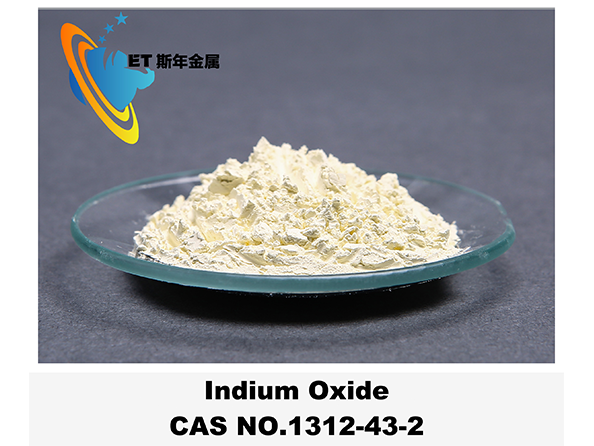
CAS #: 1312-43-2
Molecular Formula: In2O3
EC No.: 215-193-9


Indium oxide is an inorganic compound with the molecular formula In2O3. Light yellow amorphous powder, which turns reddish-brown when heated. Indium oxide is a new type of N-type transparent semiconductor functional material, featuring a wide bandgap, low resistivity and high catalytic activity. It has been widely applied in the fields of optoelectronics, gas sensors and catalysts.
Applications:
1.It is used as a spectral pure reagent and material for electronic components, etc.
2. Protective coatings for metal reflective mirrors and semiconductor films for photoelectric displays
3. It is used for manufacturing indium salts and glass.
| Product | Product Code | Security Data | Technical Data |
| Indium Oxide 99.99% | ET-In-01 | ||
| Indium Oxide 99.999% | ET-In-02 |
| Molecular Formula | In2O3 |
| Molecular Weight | 277.64 |
| Appearance | Yellow Powder |
| Melting Point | 1,910° C (3,470° F) |
| Boiling Point | N/A |
| Density | 7.18 g/cm3 |
| Precise Quality | 277.793 g/mol |
| Single Isotope Mass | 277.793 Da |
| Signal Word | N/A |
| Risk Statement | N/A |
| Dangerous Code | N/A |
| Preventive Instructions | N/A |
| Flash Point | Not applicable |
| Risk Code | N/A |
| Safety Statement | N/A |
| RTECS Number | NL1770000 |
| Transportation Information | N/A |
| WGK Germany | 3 |
Packaging Specifications:
Standard packaging: 50 kg/drum, 500 kg/pallet, ton bags
Sample packaging: 500 g/bag, 1 kg/bottle
| Indium Oxide |

|

Room 310, Building 1, No. 326, Jinyuan Third Road, Jiading District, Shanghai
Tel : +86-400-6632276
Mobile&Whatsapp : +86 19916550170
Email : sales@eternal-element.com
Scan to wechat :


