Hello!Welcome to Shanghai Sheeny Metal Materials Co.,Ltd. Website!
Hotline:+86-400-6632276

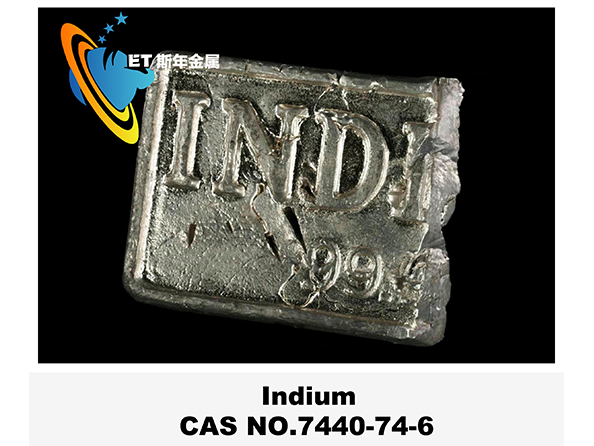
CAS #: 7440-74-6
Molecular Formula: In
EC No.: 231-180-0


Indium is a metallic element with the symbol In and atomic number 49. It is located in Group IIIA of the fifth period of the periodic table. Its elemental form is a silvery-white metal with a slight bluish tint, extremely soft and can be scratched by a fingernail. It has strong plasticity, ductility and can be pressed into sheets. Melting point: 156.61℃. Boiling point: 2060℃. Density: 7.30g/cm ³. Liquid indium can wet glass and adhere to the surface it has touched, leaving black marks.
Applications:
1.It is mainly used for the production of ITO target materials.
2. In medicine, indium colloid is used for liver, spleen and bone marrow scans.
3.It is used for the synthesis of liquid metals from gallium and indium alloys to form a solid-solution alloy.
Product | Product Code | Security Data | Technical Data |
Metallic Indium 99.99% | ET-InM-01 | ||
Metallic Indium 99.999% | ET-InM-01 |
Molecular Weight | 114.82 |
Appearance | Silvery |
Melting Point | 156.6 °C |
Boiling Point | 2080℃ |
Density | 7310 kg/m3 |
Resistivity | 8.37 microhm-cm @ 20 °C |
Electronegativity | 1.7 Paulings |
Fusion Heat | 0.781 Cal/gm mole |
Heat Of Vaporization | 53.7 K-Cal/gm atom at 2080 °C |
Poisson's Ratio | 0.4498 |
Specific Heat | 0.056 Cal/g/K @ 25 °C |
Tensile Strength | N/A |
Thermal Conductivity | 0.818 W/cm/K @ 298.2 K |
Thermal Expansion | (25 °C) 32.1 µm·m-1·K-1 |
Vickers Hardness | <10 |
Young's Modulus | 11 GPa |
Signal Word | N/A |
Disclaimer | N/A |
Dangerous Code | N/A |
Preventive Instructions | P261-P280-P305 + P351 + P338 |
Flash Point | Not applicable |
Risk Code | N/A |
Safety Statement | N/A |
RTECS Number | NL1050000 |
Transportation Information | NONH |
WGK Germany | 3 |
Packaging Specifications:
Standard packaging: 50 kg/drum, 500 kg/pallet, ton bags
Sample packaging: 500 g/bag, 1 kg/bottle
| Indium |

The extraction process of indium mainly relies on the extraction-electrolysis method, which is also the mainstream process technology for indium production in the world today. The principle process flow is as follows: indium-containing raw materials → enrichment → chemical dissolution → purification → extraction → reverse extraction → zinc (aluminum) displacement → sponge indium → electrolytic refining → refined indium. Ninety percent of the world's indium production comes from by-products of lead-zinc smelters. The main method for the smelting and recovery of indium is to recover it through enrichment from the smelting slag, molten slag and anode slime of copper, lead and zinc. Depending on the source of the recycled raw materials and the difference in indium content, different extraction processes are applied to achieve the best configuration and maximum benefit. Commonly used process technologies include oxidation slagging, metal displacement, electrolytic enrichment, acid leaching extraction, extractive electrolysis, ion exchange, and electrolytic refining, etc. At present, the solvent extraction method is widely used, which is an efficient separation and extraction process. The ion exchange method for the recovery of indium has not yet been reported to be industrialized. During the process of separating indium from the less volatile tin and copper, most of the indium is concentrated in the flue ash and scum. When separated from volatile zinc and cadmium, indium is enriched in the slag and filter residue. |

Room 310, Building 1, No. 326, Jinyuan Third Road, Jiading District, Shanghai
Tel : +86-400-6632276
Mobile&Whatsapp : +86 19916550170
Email : sales@eternal-element.com
Scan to wechat :


