Hello!Welcome to Shanghai Sheeny Metal Materials Co.,Ltd. Website!
Hotline:+86-400-6632276

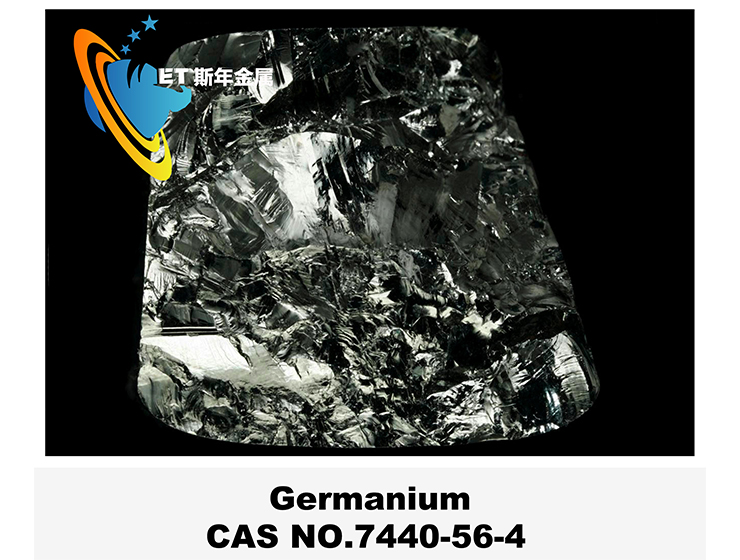
CAS # : 7440-56-4
Molecular Formula: Ge
EC Number: 231-164-3


Germanium, a chemical element with the symbol Ge, atomic number 32 and atomic weight 72.64, is located in the 4th period and IVA group of the periodic table of chemical elements. Germanium is a grayish-white quasi-metal with luster, hard texture, and belongs to the carbon group. Its chemical properties are similar to those of tin and silicon in the same group. It is insoluble in water, hydrochloric acid, and dilute caustic alkali solutions, but soluble in aqua regia, concentrated nitric acid, or sulfuric acid. It is amphoteric and thus dissolves in molten alkali, peroxide alkali, alkali metal nitrates, or carbonates. It is relatively stable in the air.
Applications:
1.It is used for making semiconductor materials.
2.It is used for making germanium oxide.
Product | Product Code | Security Data | Technical Data |
Germanium 99.99% | ET-GeM-01 | ||
Germanium 99.999% | ET-GeM-02 |
Molecular Weight | 72.61 |
Appearance | Black Lump |
Melting Point | 937.4 °C |
Boiling Point | 2830℃ |
Density | 5.323 g/cm3 |
Resistivity | microhm-cm @ 20 °C |
Electronegativity | 1.8 Paulings |
Fusion Heat | 8.3 Cal/gm mole |
Heat of Vaporization | 68 K-cal/gm atom at 2830 °C |
Poisson's Ratio | 0.26 |
Specific Heat | 0.077 Cal/g/K @ 25 °C |
Tensile Strength | N/A |
Thermal Conductivity | 0.602 W/cm/K @ 302.93 K |
Thermal Expansion | 6.0 µm/(m·K) |
Vickers Hardness | N/A |
Young's Modulus | 103 GPa |
Signal Word | N/A |
Disclaimer | N/A |
Dangerous Code | N/A |
Preventive Instructions | P261-P305 + P351 + P338 |
Flash Point | Not applicable |
Risk Code | N/A |
Safety Statement | N/A |
RTECS Number | LY5200000 |
Transportation Information | ONH |
WGK Germany | 3 |
Packaging Specifications:
Standard packaging: 50 kg/drum, 500 kg/pallet, ton bags
Sample packaging: 500 g/bag, 1 kg/bottle
| Germanium |

Germanium has stable chemical properties and does not react with air or water vapor at room temperature. However, at 600 to 700 degrees Celsius, it quickly forms germanium dioxide. It does not react with hydrochloric acid or dilute sulfuric acid. When concentrated sulfuric acid is heated, germanium will dissolve slowly. Germanium is readily soluble in nitric acid and aqua regia. The interaction between alkaline solutions and germanium is very weak, but molten alkali in the air can cause germanium to dissolve rapidly. Germanium does not react with carbon, so when melted in a graphite crucible, it will not be contaminated by carbon. Germanium oxidizes at higher temperatures and is accompanied by weight loss. The reason is that GeO is formed due to its strong volatility. Researchers studied the process of oxidation on the surface of germanium. First, they reduced germanium with CO at 600℃ to remove the bound oxygen or adsorbed oxygen on the surface of germanium. Germanium was oxidized at 25 to 400℃ under an oxygen pressure of 10 kpa, and the first oxide layer was formed in just 1 minute. When the temperature exceeds 250℃, the second layer of carbon dioxide forms quickly. When the temperature is raised further, the oxidation rate slows down significantly. After oxidation at 400℃ for 3 hours, a GeO2 film with a thickness of 1.75nm was formed. The corrosion dissolution behavior of germanium varies in different solvents. The dissolution potential of N-type germanium is slightly more positive than that of P-type, so the dissolution rate of the former is faster in the same solution. Germanium is readily soluble in hot acids, hot bases and H2O2 with oxidants added. It is insoluble in dilute sulfuric acid, hydrochloric acid and cold alkaline solution. Germanium is insoluble in water at 100℃, while in water with saturated oxygen at room temperature, its dissolution rate approaches 1μg/(cm·h). The extraction method of germanium is as follows: Firstly, the enriched germanium is chlorinated with concentrated hydrochloric acid to produce germanium tetrachloride. Then, the main impurity arsenic is removed by solvent extraction with hydrochloric acid. After that, it is purified twice through distillation in a quartz tower and washed with high-purity hydrochloric acid to obtain high-purity germanium tetrachloride. Finally, germanium tetrachloride is hydrolyzed with high-purity water to obtain high-purity germanium dioxide. Some impurities will enter the mother liquor of hydrolysis, so the hydrolysis process is also a purification process. Pure germanium dioxide is dried and calcined, and then reduced in the quartz tube of the reduction furnace with hydrogen at 650-680℃ to obtain metallic germanium. High-purity germanium (with impurities less than 1/1010) used in the semiconductor industry can be obtained by zone melting technology. 4HCl+GeO2→GeCl4+2H2O GeCl4+(n+2)H2O→GeO2·nH2O+4HCl GeO2+2H2→Ge+2H2O |

Room 310, Building 1, No. 326, Jinyuan Third Road, Jiading District, Shanghai
Tel : +86-400-6632276
Mobile&Whatsapp : +86 19916550170
Email : sales@eternal-element.com
Scan to wechat :


