Hello!Welcome to Shanghai Sheeny Metal Materials Co.,Ltd. Website!
Hotline:+86-400-6632276

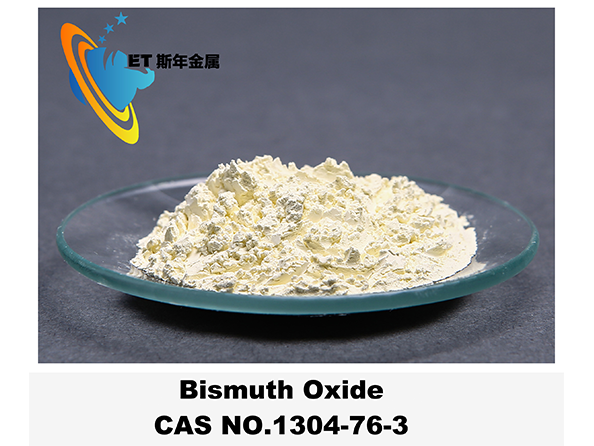
CAS #: 1304-76-3
Molecular Formula: Bi2O3
EC No.: 215-134-7


Bismuth oxide is an inorganic compound with the molecular formula Bi2O3. Pure products are available in α type, β type and δ type. The α type is a yellow monoclinic crystal system with a relative density of 8.9 and a melting point of 825 ℃. It is soluble in acids but insoluble in water and alkali. The β type is bright yellow to orange, with a cubic crystal system, a relative density of 8.55, a melting point of 860 ℃, soluble in acid but insoluble in water. It is easily reduced to metallic bismuth by hydrogen, hydrocarbons, etc. δ-Bi2O3 is a special material with a cubic fluorite mineral structure. One quarter of the oxygen ion positions in its lattice are vacant, thus it has extremely high oxygen ion conductivity.
Applications:
1.It is used for making electronic ceramic powder materials.
2. It is used for making photoelectric materials.
3. It is used for making catalysts.
4. It is used for making high-temperature superconducting materials.
5. It is used for making red glass compounding agents, etc.
Product | Product code | Security Data | Technical Data |
Bismuth oxide 99.9% | ET-Bi-01 | ||
| Bismuth oxide 99.99% | ET-Bi-02 |
| |
| Bismuth oxide 99.999% | ET-Bi-03 |
| Molecular Formula | Bi2O3 |
Molecular Weight | 465.96 |
| Appearance | Yellow Powder |
Melting Point | 817° C (1,503° F) |
Boiling Point | 1890 °C (3434 °F) |
Density | 8.9 g/cm3 |
Precise Quality | 465.945541 |
Single Isotope Mass | 465.945541 |
| Signal Word | Warning |
| Risk Statement | H315-H319-H335 |
| Dangerous Code | Xi |
| Preventive Instructions | N/A |
| Flash Point | Not applicable |
| Risk Code | 36/37/38 |
| Safety Instructions | 26-36/37 |
| RTECS | EB2984460 |
| Transportation Information | NONH |
| WGK Germany | 2 |
Packaging Specifications:
Standard packaging: 50 kg/drum, 500 kg/pallet, ton bags
Sample packaging: 500 g/bag, 1 kg/bottle
| Bismuth Oxide |

Add a sodium hydroxide aqueous solution free of carbon dioxide to the bismuth nitrate solution (80-90℃) and mix them. During the precipitation process, the solution remains alkaline and forms white, volume-expanding bismuth oxide hydrate Bi(OH)3 precipitate. When this solution is heated and stirred for a short time, it dehydrates and turns into yellow bismuth trioxide. Bismuth oxide products are obtained after water decanting, washing, filtration and drying. |

Room 310, Building 1, No. 326, Jinyuan Third Road, Jiading District, Shanghai
Tel : +86-400-6632276
Mobile&Whatsapp : +86 19916550170
Email : sales@eternal-element.com
Scan to wechat :


