Hello!Welcome to Shanghai Sheeny Metal Materials Co.,Ltd. Website!
Hotline:+86-400-6632276

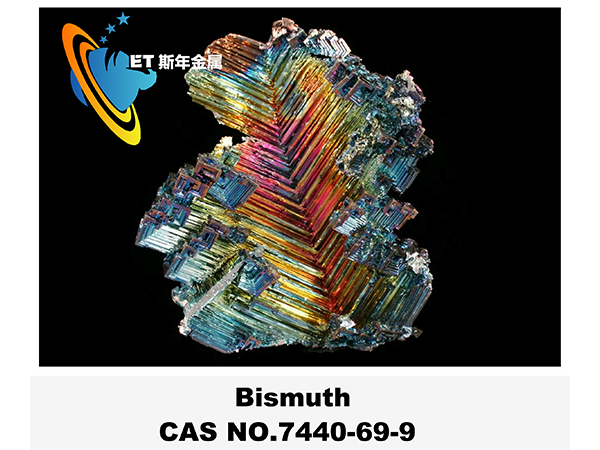
CAS #: 7440-69-9
Molecular Formula:Bi
EC No.:231-177-4


The molecular formula of metallic bismuth is Bi. It appears light gray in color, is brittle and hard, and has coarse-grained crystals in the orthorhombic crystal system. Melting point: 271.3℃. Boiling point: (1560±5)℃. Relative density: 9.80 g/cm ³ Soluble in hot sulfuric acid, nitric acid, aqua regia, slowly soluble in hot hydrochloric acid, insoluble in water. It is stable at room temperature, but when heated, it burns with a pale blue flame and generates yellow or brown bismuth oxide. Molten metal increases in volume after solidification.
Applications:
It is used for making high-purity materials for semiconductors.
2. It is used for the preparation of high-purity bismuth compounds.
3. It is used for making low-melting-point alloys.
4. It is used for making bismuth products and bismuth alloys.
Product | Product code | Security Data | Technical Data |
Metallic Bismuth 99.9% | ET-BiM-01 | ||
Metallic Bismuth 99.99% | ET-BiM-02 |
Molecular Weight | 208.98 |
Appearance | Silvery-red metal |
Melting Point | 271.3 °C |
Boiling Point | 1560℃ |
Density | 9.747 g/cm3 |
Resistivity | 106.8 microhm-cm (0 °C) |
Electronegativity | 2.02 Paulings |
Fusion Heat | 11.30 kJ/mol |
Heat of Vaporization | 151 kJ/mol |
Poisson's Ratio | 0.33 |
Specific Heat | 0.123 J/g·K (20°C) |
Tensile Strength | N/A |
Thermal Conductivity | 7.97 W/m ·K |
Thermal Expansion | (25 °C) 13.4 µm·m-1·K-1 |
Vickers Hardness | N/A |
Young's Modulus | 32GPa |
Signal Word | N/A |
Disclaimer | N/A |
Dangerous Code | N/A |
Preventive Instructions | N/A |
Risk Code | N/A |
Safety Statement | N/A |
RTECS Number | EB2600000 |
Harmonized Tariff Code | 8106.00 |
Transportation Information | NONH for all modes of transport |
WGK Germany | nwg |
Packaging Specifications:
Standard packaging: 50 kg/drum, 500 kg/pallet, ton bags
Sample packaging: 500 g/bag, 1 kg/bottle
| Bismuth |

Bismuth metal powder can spontaneously combust in chlorine gas and directly combine with bromine, iodine, sulfur and selenium when heated to form trivalent compounds. It is insoluble in dilute hydrochloric acid and dilute sulfuric acid, but soluble in nitric acid and concentrated sulfuric acid to form trivalent bismuth salt. In 1753, Ingyphrujangwa discovered bismuth. There are two forms in nature: free state and combined state. The main minerals include bismuthite and bismuthite, etc. Its abundance in the Earth's crust is 2.0×10⁻⁵%. It is mainly used for making low-melting-point alloys (with melting points above 45℃ and below 100℃), and is used in the fire protection and electrical industries as automatic fire extinguishing devices, fuses and solders. It is also used in the production of movable type alloys, medicine, etc. Bismuth trioxide is obtained by calcining bismuth pyrophyllite, which is then thermally reduced with carbon to yield Bismuth. |

Room 310, Building 1, No. 326, Jinyuan Third Road, Jiading District, Shanghai
Tel : +86-400-6632276
Mobile&Whatsapp : +86 19916550170
Email : sales@eternal-element.com
Scan to wechat :


