Hello!Welcome to Shanghai Sheeny Metal Materials Co.,Ltd. Website!
Hotline:+86-400-6632276

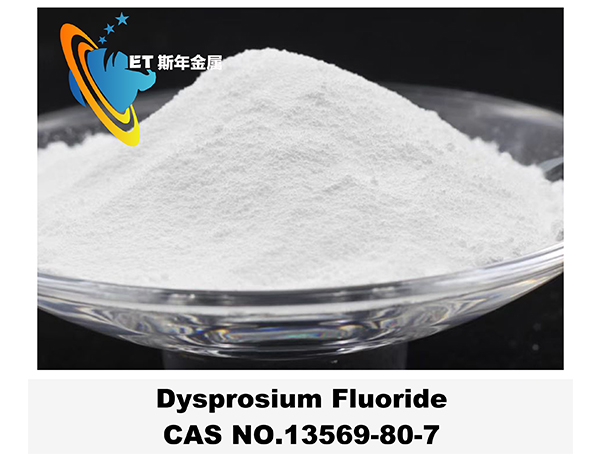
CAS #: 13569-80-7
Molecular Formula: DyF3
EC No.: 236-992-9


Dysprosium(III) fluoride is a Inorganic compound with Molecular formula DyF3. White powder, density 5.95 g/cm3. Melting point 1360 ° C, boiling point>2200 ° C, insoluble in water, insoluble in hydrochloric acid, nitric acid and sulfuric acid, but soluble in Perchloric acid. It has hygroscopicity in the air and is relatively stable.
Applications:
1. Prepare scintillators that meet the requirements of modern medical image display technology and nuclear science.
2. Rare earth crystal laser materials.
3. Fluoride glass 、Optical fiber and Rare Earth infrared glass.
4. Manufacturing special alloys and electrolytic production of Dysprosium metal.
Product | Product Code | Security Data | Technical Data |
Dysprosium Fluoride 99.9% | ET-DyF |
|
Molecular Formula | DyF3 |
Molecular Weight | 219.5 |
Appearance | White |
Melting Point | 1360°C (2480°F) |
Boiling Point | 2200 °C (3992 °F) |
Density | 5.948 g/cm3 |
Precise Quality | 220.924 g/mol |
Single Isotope Mass | 220.92441 Da |
Signal Word | Warning |
Risk Statement | N/A |
Dangerous Code | Xi |
Preventive Instructions | N/A |
Flash Point | N/A |
Risk Code | 36/37/38 |
Safety Statement | 26 |
RTECS Number | N/A |
Transportation Information | NONH for all modes of transport |
WGK Germany | 3 |
Packaging Specifications:
Standard packaging: 50 kg/drum, 500 kg/pallet, ton bags
Sample packaging: 500 g/bag, 1 kg/bottle
| Dysprosium Fluoride |

Purification and separation of other impurities from chloride raw materials, introduction of carbon dioxide to form carbonates, and reaction with high-purity fluoride in special equipment to generate fluoride salts. The reaction products are washed with hot pure water, and dried and dehydrated in a vacuum furnace. Adjust the temperature to remove free fluorine. Injecting hydrogen gas to transform the crystal phase changes the refractive index. Purify and separate other impurities from chloride raw materials, control the concentration and temperature, and add fluoride salt to react and precipitate to generate fluoride salt slurry. Wash with hot pure water to remove anions. Vacuum furnace dehydration. Remove free fluorine. Injecting hydrogen gas to transform the crystal phase changes the refractive index. |

Room 310, Building 1, No. 326, Jinyuan Third Road, Jiading District, Shanghai
Tel : +86-400-6632276
Mobile&Whatsapp : +86 19916550170
Email : sales@eternal-element.com
Scan to wechat :


