Hello!Welcome to Shanghai Sheeny Metal Materials Co.,Ltd. Website!
Hotline:+86-400-6632276

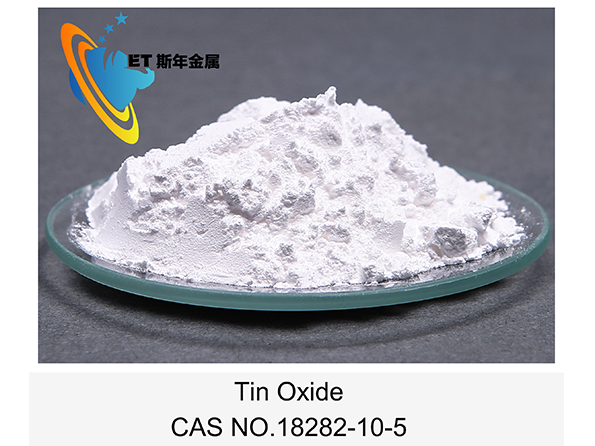
CAS #: 18282-10-5
Molecular Formula: Sn02
EC No.: 242-159-0


Tin dioxide is also known as "tin oxide". Chemical formula: SnO2 Molecular weight: 150.69. White tetragonal (also hexagonal or orthorhombic) crystals, which turn yellow when heated. Melting point: 1127℃, sublimation at 1800-1900℃, relative density: 6.95, refractive index: 1.997, 2.093. Tin dioxide is stable to air and heat. It is insoluble in water and slightly soluble in acid or alkali solutions, but it can dissolve in hot concentrated sulfuric acid, molten caustic alkali and potassium hydroxide, and is slightly soluble in alkali metal carbonate solutions. It does not react with common chemical reagents and does not react with nitric acid. When heated with concentrated HCl, it gradually turns into chloride and dissolves. It is reduced to metallic tin by reacting with hydrogen at high temperatures. It reacts with CO to produce metallic tin and CO2, and the reaction is reversible.
Applications:
1. Electronics industry
● transparent conductive film : It is used in the manufacturing of liquid crystal displays (LCDS), touch screens, solar cells and other devices due to its high electrical conductivity and light transmittance.
● gas sensor : It can detect flammable gases, toxic gases and environmentally polluting gases, with high sensitivity and fast response speed.
● varistor : By doping metal oxides (such as CoO, Nb₂O₅, etc.) to adjust the resistance value, it is widely used in power systems and household appliance circuit protection.
2.Glass and ceramics industry
● glass manufacturing : As a clarifying agent and colorant, it enhances the transparency, hardness and heat resistance of glass, such as opal glass, optical glass, etc.
● ceramic glaze : Enhances the gloss, wear resistance and corrosion resistance of ceramic products, commonly found in tiles and sanitary wares.
3.Catalysts and environmental applications
● organic synthesis and exhaust gas treatment : Catalytic oxidation reactions are used to produce nitric acid and acetic acid, and it is also used for the purification of carbon monoxide and hydrocarbons in vehicle exhaust.
● photocatalytic degradation of pollutants : decomposition of organic pollutants in wastewater treatment and air purification.
4.Other industrial uses
● Coatings and pigments : As a white pigment and anti-corrosion component, it enhances the hardness, high-temperature resistance and wear resistance of coatings.
● special materials : used for silver-tin oxide electrical contacts (as a substitute for toxic silver-cadmium oxide materials), electrode materials and polishing agents, etc.
| Product | Product Code | Security Data | Technical Data |
| Tin Oxide 99.995% | ET-Sn-01 |
| Molecular Formula | Sn02 |
| Molecular Weight | 134.71 |
| Appearance | White to gray powder |
| Melting Point | 1080 °C |
| Boiling Point | Not applicable |
| Density | 6.51 g/cm3 |
| Precise Quality | 135.897109 |
| Single Isotope Mass | 135.897109 |
| Signal Word | Not applicable |
| Risk Statement | Not applicable |
| Dangerous Code | Not applicable |
| Risk Code | Not applicable |
| Safety Statement | Not applicable |
| RTECS Number | XQ3700000 |
| Transportation Information | NONH |
| WGK Germany | 3 |
Packaging Specifications:
Standard packaging: 50 kg/drum, 500 kg/pallet, ton bags
Sample packaging: 500 g/bag, 1 kg/bottle
| Tin Oxide |

Tin oxide exists in nature in the form of stannite. Cassiterite is generally reddish-brown in color, in the form of fine particles or blocks, and is mostly dispersed in granite. It is the main mineral for extracting tin. Tin oxide is stable to air and heat. It is insoluble in water and slightly soluble in acid or alkali solutions, but it can dissolve in hot concentrated sulfuric acid, molten caustic alkali and potassium hydroxide, and is slightly soluble in alkali metal carbonate solutions. It does not react with common chemical reagents and does not react with nitric acid. When heated with concentrated HCl, it gradually turns into chloride and dissolves. It is reduced to metallic tin by reacting with hydrogen at high temperatures. It reacts with CO to produce metallic tin and CO2, and the reaction is reversible. Preparation: Tin oxide can be obtained by burning tin in air, or by the reaction of tetravalent soluble tin salts with alkali, or by the reaction of metallic tin with concentrated HNO3 to form β -stannic acid precipitate, which is then heated and dehydrated. |

Room 310, Building 1, No. 326, Jinyuan Third Road, Jiading District, Shanghai
Tel : +86-400-6632276
Mobile&Whatsapp : +86 19916550170
Email : sales@eternal-element.com
Scan to wechat :


