Hello!Welcome to Shanghai Sheeny Metal Materials Co.,Ltd. Website!
Hotline:+86-400-6632276

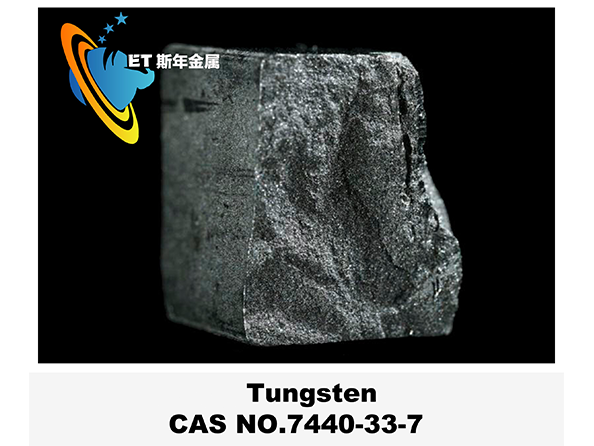
CAS # : 7440-33-7
Molecular Formula: W
EC No.: 231-143-9


Tungsten is a metallic element with the symbol W and atomic number 74. It belongs to Group VIB in the sixth period of the periodic table. Tungsten is mainly a hexavalent cation in nature, with an ionic radius of 0.68×10⁻¹⁰m. Due to the small ionic radius, high valence and strong polarization ability of W6+, it is prone to form complex anions. Therefore, tungsten mainly combines with cations such as Fe2+, Mn2+ and Ca2+ in the solution in the form of complex anions [WO4]2- to form wolframite or scheelite precipitates.
Applications:
1.It is used for tungsten carbide-based cemented carbide
2. For heat-resistant and wear-resistant alloys
3. It is used for contact materials and high-density alloys
4. For heat-resistant materials.
| Product | Product Code | Security Data | Technical Data |
Metallic Tungsten 99.95% | ET-WM-01 |
| Molecular Weight | 183.85 |
| Appearance | Silvery |
| Melting Point | 3410℃ |
| Boiling Point | 5900℃ |
| Density | 19.3 g/cm3 |
| Resistivity | 5.65 microhm-cm @ 27°C |
| Electronegativity | 1.7 Paulings |
| Heat of Vaporization | 185 K-Cal/gm atom at 5660°C |
| Poisson's Ratio | 0.28 |
| Specific Heat | 0.0317 Cal/g/K @ 25°C |
| Tensile Strength | 750MPa |
| Thermal Conductivity | 1.73 W/cm/K @ 298.2 K |
| Thermal Expansion | (25 °C) 4.5 µm·m-1·K-1 |
| Vickers Hardness | 3430 MPa |
| Young's Modulus | 411 GPa |
| Signal Word | Danger |
| Risk Statement | H301-H315-H317-H319-H330-H335-H350i-H372 |
| Dangerous Code | T+ |
| Preventive Instructions | P201-P260-P280-P284-P301 + P310-P305 + P351 + P338 |
| Flash Point | Not applicable |
| Risk Code | 49-25-26-36/37/38-43-48/23 |
| Safety Statement | 53-45 |
| RTECS Number | DS4025000 |
| Transportation Information | UN 1566 6.1 / PGII |
| WGK Germany | 3 |
| GHS Pictogram |   |
Packaging Specifications:
Standard packaging: 50 kg/drum, 500 kg/pallet, ton bags
Sample packaging: 500 g/bag, 1 kg/bottle
| Tungsten |

About 50% of the tungsten ore mined in the world is used for smelting high-quality steel, about 35% for producing hard steel, about 10% for making tungsten wire, and about 5% for other purposes. Tungsten has a wide range of applications, and the most common one is tungsten carbide (WC) cemented carbide. Such hard alloys are commonly used as durable metals in metal processing, mining, oil extraction and construction industries. In addition, tungsten filaments are also widely used in light bulbs and vacuum tubes. Tungsten is also commonly used as an electrode. Tungsten is extremely hard and compact, making it an ideal choice for making heavy metal alloys. Such alloys are used in armor, heat sinks, and high-density applications such as heavy objects, balancing heavy objects, and heavy objects for ships and aircraft. Because tungsten is very dense, darts often contain 80% to 97% tungsten. High-speed steel contains tungsten, sometimes 18% tungsten. High-temperature alloys used for manufacturing turbine blades, durable parts and protective layers contain tungsten (such as Hastelloy, tungsten-chromium-cobalt alloy, etc.). Compounds of tungsten can be used as catalysts. |

Room 310, Building 1, No. 326, Jinyuan Third Road, Jiading District, Shanghai
Tel : +86-400-6632276
Mobile&Whatsapp : +86 19916550170
Email : sales@eternal-element.com
Scan to wechat :


