Hello!Welcome to Shanghai Sheeny Metal Materials Co.,Ltd. Website!
Hotline:+86-400-6632276

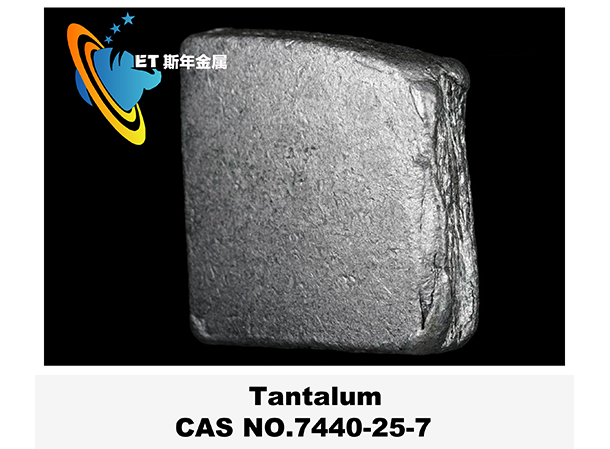
CAS # : 7440-25-7
Molecular Formula: Ta
EC No.: 231-135-5


Tantalum and its alloys have high melting points, high strength and ductility, and possess excellent chemical corrosion resistance. Tantalum carbide graphite composite material is one of the hardest substances ever. It is blue in its rough state, but when polished, it has a silvery luster. The melting point exceeds 6,700°C. Pure metals are malleable and tough, and can be drawn into fine wires, hammered and processed into various shapes. Tantalum fine wire will ignite in the air when exposed to a flame.
Applications:
It is used for making high-temperature alloys and superconducting alloys.
2. It is used for manufacturing electrolytic capacitors and vacuum furnace parts.
3. It is used for making sputtering targets.
Product | Product Code | Security Data | Technical Data |
Metallic Tantalum 99.9% | ET-TaM-01 | ||
Metallic Tantalum 99.99% | ET-TaM-02 |
Molecular Weight | 180.94 |
Appearance | Silvery-gray solid |
Melting Point | 3017℃ |
Boiling Point | 5458℃ |
Density | 16.69 g/cm3 (20 °C) |
Crystal Phase/Structure | α: body-centered cubic (bcc) / β: tetragonal |
Resistivity | 131 nΩ·m (20 °C) |
Electronegativity | 1.5 Paulings |
Fusion Heat | 36.57 kJ/mol |
Heat of Vaporization | 753 kJ/mol |
Poisson's Ratio | 0.34 |
Specific Heat | 140J/kg·K |
Thermal Conductivity | 57.5 W/m·K |
Thermal Expansion | 6.3 µm/m·K |
Vickers Hardness | 870–1200 MPa |
Young's Modulus | 186 GPa |
Signal Word | N/A |
Disclaimer | N/A |
Dangerous Code | N/A |
Preventive Instructions | P261 - P264 - P270 - P271 - P301+P312 - P304+P340 - P305+P351+P338 - P312 - P330 - P337+P313 - P403+P233 - P405 - P501 |
Flash Point | Not applicable |
Risk Code | N/A |
Safety Statement | N/A |
RTECS Number | N/A |
Transportation Information | NONH |
WGK Germany | nwg |
Packaging Specifications:
Standard packaging: 50 kg/drum, 500 kg/pallet, ton bags
Sample packaging: 500 g/bag, 1 kg/bottle
| Tantalum |

Smelting method: Tantalum-niobium ores often contain multiple metals. The main steps in tantalum smelting are to decompose the concentrate, purify and separate tantalum and niobium to produce pure compounds of tantalum and niobium, and finally to obtain the metal. Ore decomposition can be carried out by methods such as hydrofluoric acid decomposition, sodium hydroxide melting and chlorination. Tantalum and niobium separation can be achieved by solvent extraction (commonly used extractants include methyl isobutyl copper (MIBK), tributyl phosphate (TBP), sec-octanol and acetamide, etc.), stepstep crystallization and ion exchange methods. The preparation of tantalum: ① Metallic tantalum powder can be produced by the metal thermal reduction (sodium thermal reduction) method. Reduction of potassium fluorotantalate with metallic sodium in an inert atmosphere: K2TaF7+5Na →Ta+5NaF+2KF. The reaction takes place in a stainless steel tank. When the temperature is heated to 900℃, the reduction reaction is completed rapidly. The tantalum powder produced by this method has an irregular particle shape and fine particle size, and is suitable for making tantalum capacitors. Tantalum powder can also be produced by the molten salt electrolysis method: using a molten salt of a mixture of potassium fluorotantalate, potassium fluoride and potassium chloride as the electrolyte, dissolving tantalum pentoxide (Ta2O5) in it, and electrolyzing at 750℃, tantalum powder with a purity of 99.8% to 99.9% can be obtained. ② Metallic tantalum can also be obtained by carbothermal reduction of Ta2O5. Reduction is generally carried out in two steps: Firstly, a mixture of Ta2O5 and carbon in a certain proportion is made into tantalum carbide (TaC) in a hydrogen atmosphere at 1800 to 2000℃. Then, TaC and Ta2O5 are made into a mixture in a certain proportion and vacuum reduced to metallic tantalum. Metallic tantalum can also be produced by thermal decomposition or hydrogen reduction of tantalum chlorides. Dense metallic tantalum can be prepared by vacuum arc, electron beam, plasma beam smelting or powder metallurgy methods. High-purity tantalum single crystals were prepared by the crucible electron beam zone melting method. |

Room 310, Building 1, No. 326, Jinyuan Third Road, Jiading District, Shanghai
Tel : +86-400-6632276
Mobile&Whatsapp : +86 19916550170
Email : sales@eternal-element.com
Scan to wechat :


