Hello!Welcome to Shanghai Sheeny Metal Materials Co.,Ltd. Website!
Hotline:+86-400-6632276

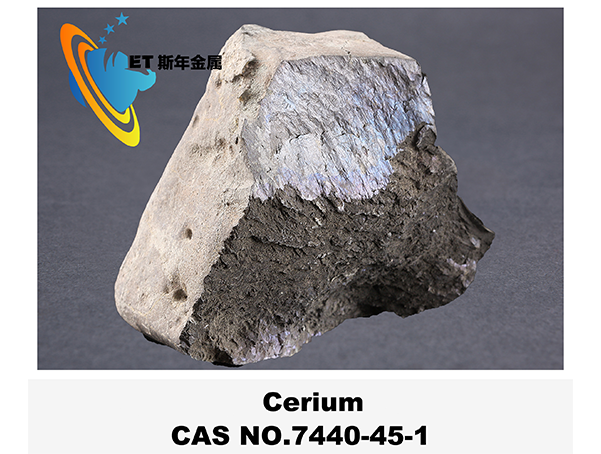
CAS #: 7440-45-1
Linear Formula: Ce
EC No.: 231-154-9


Cerium, a gray and active metal, has a density of 6.9g/cm ³ (cubic crystal) and 6.7g/cm ³ (hexagonal crystal), a melting point of 795 ° C, a boiling point of 3443 ° C, and is malleable. It is the lanthanide metal with the highest natural abundance. When bending cerium strips, sparks often fly out.
Applications:
Metal cerium shells are used in the production of nickel-metal-hydride batteries, which is one of the most important applications of cerium.
2. It is mainly used for manufacturing special alloys. 【 Flint, spheroidizing agent, etc.
PRODUCT | Product Code | SAFETY DATA | TECHNICAL DATA |
Cerium Metal 99.9% | ET-CeM-01 | ||
Cerium Metal 99.99% | ET-CeM-02 |
Molecular Weight | 140.12 |
Appearance | Silvery |
Melting Point | 795°C |
Boiling Point | 3360℃ |
Density | 6689kg/m 3 |
Resistivity | 75.0 microhm-cm @ 25 °C |
Electronegativity | 1.1 Paulings |
Fusion Heat | 2.12 Cal/gm mole |
Heat of Vaporization | 95 K-cal/gm atom at 3426 °C |
Poisonby | 0.24 |
Specific Heat | 0.049 Cal/g/K @ 25 °C |
Tensile Strength | N/A |
Thermal Conductivity | 0.113/cm/K @ 298.2 K |
Thermal Expansion | (rt) 6.3 µm/(m·K) |
Vickers Hardness | 270 MPa |
Young's Modulus | 33.6 GPa |
Signal Word | Danger |
Risk Statement | H228-H302-H312-H315-H319-H332-H335 |
Dangerous Code | F, Xn |
Preventive Instructions | P210-P231+P232-P280-P240-P241-P233-P370+P378c-P335+P334-P402+P404-P501a |
Flash Point | N/A |
Risk Code | 11-20/21/22-36/37/38 |
Safety Statement | 16-26-36/37/39 |
RTECS Number | N/A |
Transportation Information | UN 1333 4.1/PG 2 |
WGK Germany | 3 |
GHS Pictogram |
|
Packaging Specifications:
Standard packaging: 50 kg/drum, 500 kg/pallet, ton bags
Sample packaging: 500 g/bag, 1 kg/bottle
| Cerium |

After cerium is separated from other rare earth elements through ion exchange or solvent extraction technology, metallic cerium can be prepared by the metal thermal reduction method. Lithium thermal reduction of rare earth chlorides is different from calcium thermal reduction of rare earth chlorides. The reduction process of the former takes place in the gas phase. The lithium thermal reduction reactor is divided into two heating zones, and the reduction and distillation processes are carried out in the same equipment. Anhydrous cerium chloride is placed in the titanium reactor crucible at the top (also the CeCl3 distillation chamber), while the reducing agent metallic lithium is placed in the crucible at the bottom. Then, the stainless steel reaction tank is evacuated to 7Pa and heating begins. When the temperature reaches 1000℃, it is maintained for a certain period of time to allow the CeCl3 vapor to fully react with the lithium vapor. The solid cerium metal particles reduced out fall into the crucible at the bottom. After the reduction reaction is completed, only the lower crucible is heated and the LiCl is distilled to the upper crucible. The reduction reaction process usually takes about 10 hours. To obtain relatively pure metallic cerium, the reducing agent metallic lithium should be 99.97% high-purity lithium, and anhydrous CeCl3 obtained through secondary distillation should be used. |

Room 310, Building 1, No. 326, Jinyuan Third Road, Jiading District, Shanghai
Tel : +86-400-6632276
Mobile&Whatsapp : +86 19916550170
Email : sales@eternal-element.com
Scan to wechat :


