Hello!Welcome to Shanghai Sheeny Metal Materials Co.,Ltd. Website!
Hotline:+86-400-6632276

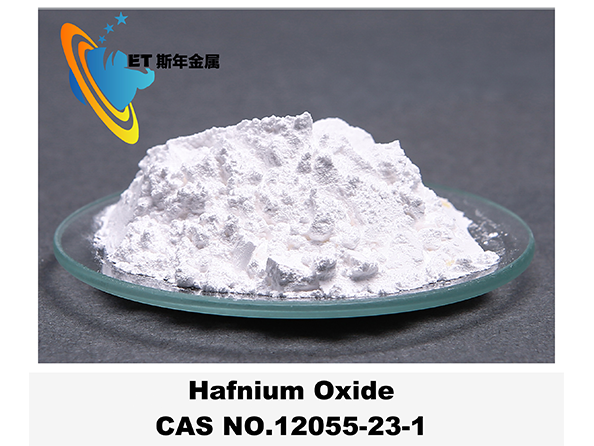
CAS #: 12055-23-1
Molecular Formula: HfO2
EC No.: 235-013-2


Hafnium oxide (HfO2) is a white crystalline powder. Pure hafnium oxide exists in three forms: one is in an amorphous state, and the other two are crystals. Amorphous hafnium oxide can be obtained when unstable compounds such as hafnium hydroxide and hafnium oxychloride are calcined at a temperature below 400℃. When hafnium oxide is further heated to 450-480℃, it begins to transform into monoclinic crystals. When further heated to 1000-1650℃, a trend of gradually increasing lattice constant occurs, and it is transformed into a monomer of 4 hafnium oxide molecules. It begins to transform into the tetragonal crystal system at 1700 to 1865℃.
Applications:
It is used in the field of optical coating production.
2. It is used for manufacturing high-efficiency integrated circuits.
3. It is used for manufacturing high-performance ceramics.
| Product | Product Code | Security Data | Technical Data |
| Hafnium Oxide 99.9% | ET-Hf-01 | ||
| Hafnium Oxide 99.99% | ET-Hf-02 |
| Molecular Formula | HfO 2 |
| Molecular Weight | 210.49 |
| Appearance | Silver |
| Melting Point | 2900 °C (5250 °F) |
| Boiling Point | 5,400° C (9,752° F) |
| Density | 9.7 g/cm3 |
| Resistivity | 9 10x Ω-m |
| Specific Heat | 120 J/kg-K |
| Thermal Conductivity | 1.1 W/mK |
| Thermal Expansion | 6.0 µm/mK |
| Young's Modulus | 57 GPa |
| Precise Quality | 251.989 g/mol |
| Single Isotope Mass | 211.936329 Da |
| Signal Word | N/A |
| Risk Statement | N/A |
| Dangerous Code | N/A |
| Preventive Instructions | N/A |
| Flash Point | Not applicable |
| Risk Code | N/A |
| Safety Statement | N/A |
| RTECS Number | N/A |
| Transportation Information | NONH |
| WGK Germany | 3 |
Packaging Specifications:
Standard packaging: 50 kg/drum, 500 kg/pallet, ton bags
Sample packaging: 500 g/bag, 1 kg/bottle
| Hafnium Oxide |

Hafnium oxide (HfO2) is a product of the separation of zirconium and hafnium. Currently, only countries such as the United States and France produce hafnium oxide when manufacturing nuclear-grade zirconium. China has long had the capacity to produce nuclear-grade zirconium and a small amount of hafnium oxide. However, the quantity of the products is scarce and their prices are high. As the main chemical product of hafnium, it is usually used as an optical coating material. A very small amount has begun to be tested in high-efficiency integrated circuits, and the application of hafnium oxide in high-end fields remains to be developed. Hafnium dioxide (HfO2) is an oxide with a relatively high dielectric constant. As a dielectric material, HfO2 is regarded as an ideal material to replace the traditional SiO2 dielectric layer in field-effect transistors due to its high dielectric constant value (~20), large bandgap width (~5.5eV), and good stability on silicon substrates. If the size of complementary metal-oxide-semiconductor devices is less than 1μm, the technology using silicon dioxide as the traditional gate dielectric will bring a series of problems such as increased heat generation of the chip and polysilicon loss. As the size of transistors shrinks, the silicon dioxide dielectric must be thinner and thinner. However, the value of leakage current will increase sharply as the thickness of the silica medium decreases due to the influence of quantum effects. Therefore, there is an urgent need for a more feasible substance to replace silica as the gate medium. Hafnium dioxide is a ceramic material with a wide bandgap and high dielectric constant. Recently, it has attracted extreme attention in the industrial sector, especially in the field of microelectronics, as it is likely to replace silicon dioxide (SiO2), the gate insulating layer of the metal-oxide-semiconductor field-effect transistor (MOSFET), the core component of current silicon-based integrated circuits. To solve the size limit problem of the development of the traditional SiO2/Si structure in MOSFETs at present. |

Room 310, Building 1, No. 326, Jinyuan Third Road, Jiading District, Shanghai
Tel : +86-400-6632276
Mobile&Whatsapp : +86 19916550170
Email : sales@eternal-element.com
Scan to wechat :


