Hello!Welcome to Shanghai Sheeny Metal Materials Co.,Ltd. Website!
Hotline:+86-400-6632276

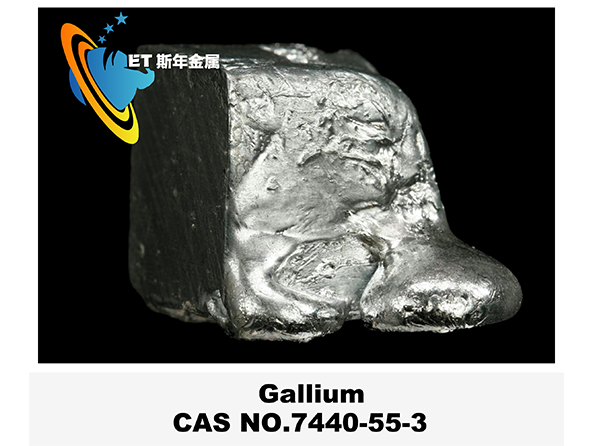
CAS # : 7440-55-3
Molecular Formula: Ga
EC No.: 231-163-8


Gallium is a chemical element with the symbol "Ga", atomic number 31, located in Group 13 of the periodic table. It is a metal-poor metal and shares similar properties with aluminium, indium and thallium. In nature, it is often scattered in trace amounts in ores such as zinc ore and bauxite. Under standard temperature and pressure, gallium is a soft, silvery metal. At low temperatures, it becomes a brittle solid. When the temperature exceeds 29.76°C (85.57°F), it becomes liquid, so this metal will melt into a person's hand (the average human body temperature is 37°C (99°F)).
Applications:
It can be used in gallium alloys and also in thermometers.
2. Additives used in neodymium iron boron magnetic materials.
3. Dopants for semiconductor substrates.
Product | Product code | Security Data | Technical Data |
Metallic Gallium 99.99% | ET-GaM-01 | ||
Metallic Gallium 99.999% | ET-GaM-02 |
Molecular Weight | 69.72 |
Appearance | Silvery |
Melting Point | 29.78 °C |
Boiling Point | 2403℃ |
Density | 5.91 g/cm3 |
Resistivity | 0.089 Cal/g/K (25 °C) |
Electronegativity | 1.81 Pauings |
Fusion Heat | 5.59 kJ/mol |
Heat Of Vaporization | 254 kJ/mol |
Poisson's Ratio | 0.47 |
Tensile Strength | 0.089 calories per gram per K (25 °C) |
Tensile Strength | N/A |
Thermal Conductivity | 0.281 W/cm·K (302.93 K) |
Thermal Expansion | (25 °C) 18 µm·mol -1 ·K -1 |
Vickers Hardness | N/A |
Young's Modulus | 9.8 GPa |
Signal Word | Warning |
Hazard Description | H290 |
Dangerous Code | N/A |
Preventive Instructions | P234-P390-P406 |
Flash Point | N/A |
Risk Code | N/A |
Safety Statement | N/A |
RTECS Number | LW8600000 |
Transportation Information | UN 2803 8/PG 3 |
WGK Germany | 3 |
GHS Pictogram |  |
Packaging Specifications:
Standard packaging: 50 kg/drum, 500 kg/pallet, ton bags
Sample packaging: 500 g/bag, 1 kg/bottle
| Gallium |

Gallium is a by-product in the processes of aluminium and zinc smelting, yet very little gallium can be obtained from sphalerite. Most of the gallium is extracted from the aluminum hydroxide solution roughly refined in the Bayer process. Sodium K-galliate is obtained through the electrolysis of mercury batteries and the hydrolysis of amalgam in sodium hydroxide, and then gallium is obtained through electrolysis. Gallium, a semiconductor, needs to be purified by zone melting technology or single crystals extracted from the molten material (i.e., the Chaser method). 99.9999% pure gallium can now be routinely obtained and is widely used in business. Industrial production uses industrial-grade metallic gallium as raw material and further purifies it by electrolysis, vacuum distillation, stepwise crystallization and zone melting methods to obtain high-purity gallium. The electrolytic method uses industrial-grade gallium with a purity of 99.99% as raw material and, through electrolytic refining and other processes, produces high-purity gallium with a purity of ≥99.999%. Using high-purity gallium with a purity of ≥ 99.999% as raw material, it is further purified through single crystal drawing or other purification processes to obtain high-purity gallium with a purity of ≥ 99.99999%. |

Room 310, Building 1, No. 326, Jinyuan Third Road, Jiading District, Shanghai
Tel : +86-400-6632276
Mobile&Whatsapp : +86 19916550170
Email : sales@eternal-element.com
Scan to wechat :


