Hello!Welcome to Shanghai Sheeny Metal Materials Co.,Ltd. Website!
Hotline:+86-400-6632276

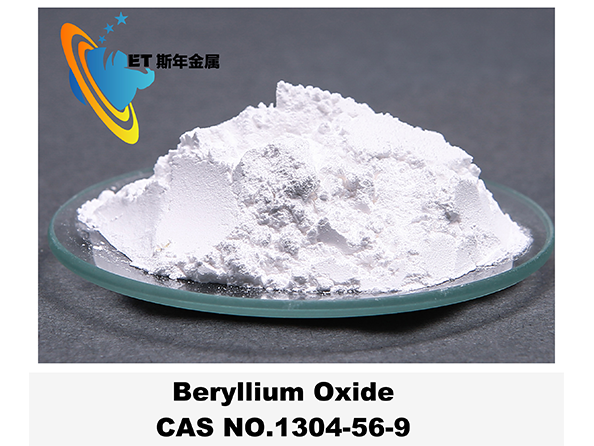
CAS #: 1304-56-9
Molecular Formula: BeO
EC No.: 215-133-1


Beryllium oxide, an inorganic compound with the chemical formula BeO, is amphoteric and can react with both acids and strong bases. It appears as a white powder. Due to its extremely high melting point and excellent thermal conductivity, it is generally used to be added to beryllium oxide ceramics for microwave high-power vacuum devices and microelectronic packaging devices.
Applications:
1.In the nuclear industry, beryllium oxide is highly suitable for manufacturing reflectors, retarders and diffusion-phase fuel matrices in reactors due to its higher particle scattering cross-section and reduction ratio than beryllium and graphite, as well as its greater density. It also has high strength and thermal conductivity at high temperatures. At the same time, it can also be applied to nuclear reactors in facilities such as ships and warships.
2. In the military and aerospace fields, beryllium oxide, with its high heat capacity and heat transfer performance, is generally used as the shell for rockets and missiles to re-enter the atmosphere, the nozzle of rockets, or as a refractory material in the new generation of supersonic aircraft. Meanwhile, due to its excellent thermal shock stability, it can be used to make the blades of gas turbine turbines.
3. In the field of ceramic materials [4], among various oxide ceramics, beryllium oxide ceramics have the best thermal conductivity, the largest specific heat value, and possess characteristics such as high strength, high rigidity, high melting point, and dimensional stability. They are widely used in the electronics industry. It is often applied in fields such as electrical insulators, semiconductor devices, transistor bases, and microwave antenna Windows.
4. In the field of refractory materials, beryllium oxide has a high unit resistance and strong resistance to carbon reduction, making it an excellent refractory material. It is generally used as the material for the reflective screen in induction furnaces and can also be applied to electric furnaces heated by tungsten heating elements. At the same time, it also has a high heat of formation and a low partial pressure of oxygen, making it difficult to be reduced. Therefore, it can also be used to prepare crucibles for heating during uranium extraction.
5. In other fields, beryllium oxide can also be used in special coatings to enhance the thermal stability and corrosion resistance of materials, etc. For instance, adding beryllium oxide to glass allows X-rays to pass through, which can be used in structural analysis and medical treatment, etc. It can also be combined with zirconium, molybdenum or other refractory metals to form high-temperature resistant beryllium compounds, which are used in the preparation of anti-corrosion materials for the exterior of aircraft.
| Product | Product Code | Security Data | Technical Data |
| Beryllium Oxide 99.5% | ET-Be-01 | ||
| Beryllium Oxide 99.9% | ET-Be-02 |
| Molecular Formula | BeO |
| Molecular Weight | 25.01 |
| Appearance | White powder |
| Melting Point | 2507 °C (4545 °F) |
| Boiling Point | 3900 °C (7052 °F) |
| Density | 2.9g/cm3 |
| Resistivity | 13 10x Ω-m |
| Poisson's Ratio | 0.26 |
| Specific Heat | 1050 J/kg-K |
| Tensile Strength | 140 MPa (Ultimate) |
| Thermal Conductivity | 270 W/m-K |
| Thermal Expansion | 8.0 µm/mK |
| Young's Modulus | 350 Mr |
| Precise Quality | 25.0071 |
| Single Isotope mass | 25.007097 GPa |
| Signal Word | Danger |
| Risk Statement | H301-H315-H317-H319-H330-H335-H350i-H372 |
| Dangerous Code | T+ |
| Preventive Instructions | P201-P260-P280-P284-P301 + P310-P305 + P351 + P338 |
| Flash Point | Not applicable |
| Risk Code | 49-25-26-36/37/38-43-48/23 |
| Safety Statement | 53-45 |
| RTECS Number | DS4025000 |
| Transportation Information | UN 1566 6.1 / PGII |
| WGK Germany | 3 |
| GHS Pictogram |   |
Packaging Specifications:
Standard packaging: 50 kg/drum, 500 kg/pallet, ton bags
Sample packaging: 500 g/bag, 1 kg/bottle
| Beryllium Oxide |

Given the distribution characteristics of mineral resources in our country, beryllium oxide concentrate, limestone and sulfuric acid are generally used as raw materials for the production of beryllium oxide. At present, the following three processes are mainly adopted by domestic and foreign enterprises: sulfuric acid method, sulfuric acid extraction method and fluorination method. 1. Sulfuric acid method: The sulfuric acid method involves melting berylene and limestone in an electric arc furnace at high temperatures, then quenching them in water. After heating to over 100 degrees Celsius, concentrated sulfuric acid is rapidly added for acidification. The generated sulfate is leached and filtered in the leaching tank, allowing metals such as beryllium, iron and aluminum to enter the solution to achieve separation from silicon, calcium and other substances. After removing iron and aluminum elements from the solution, sodium hydroxide is added for stirring, filtration, drying and calcination, and industrial beryllium oxide can be obtained. The total recovery rate of this method can reach about 75%. 2. Sulfuric acid extraction method: This method is an improved version of the sulfuric acid method. The process uses beryllium sulfate solution containing impurities such as aluminum and iron, which is obtained through high-temperature smelting, water quenching, acidification, and leaching with beryllium sulfate. The solution is then extracted with an extractant, followed by the addition of sodium hydroxide for reverse extraction. The temperature is raised to 70 degrees Celsius, and after hydrolysis, Be(OH)2 can be obtained. Industrial beryllium oxide is produced by high-temperature calcination. 3. Fluorination method: The fluorination method involves the reaction of beryl with sodium fluosilicate and sodium carbonate at 750 degrees to form soluble sodium fluoroberylliate, which is then separated from impurities. Adding alkali to the filtrate generates beryllium hydroxide precipitate, which can be calcined at high temperature to obtain industrial beryllium oxide. The total recovery rate of this method can reach about 85%. |

Room 310, Building 1, No. 326, Jinyuan Third Road, Jiading District, Shanghai
Tel : +86-400-6632276
Mobile&Whatsapp : +86 19916550170
Email : sales@eternal-element.com
Scan to wechat :


