Hello!Welcome to Shanghai Sheeny Metal Materials Co.,Ltd. Website!
Hotline:+86-400-6632276

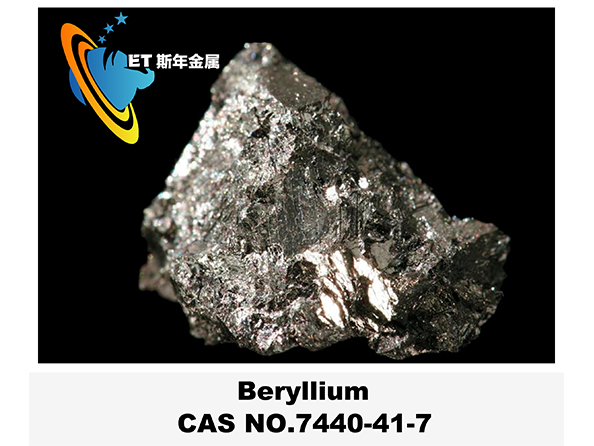
CAS # : 7440-41-7
Molecular Formula: Be
EC No.: 231-150-7


Beryllium, with the molecular formula Be and atomic number 4, belongs to the second period, second main group elements and is also the lightest alkaline earth metal element. Beryllium metal is steel gray in color, with a melting point of 1283℃, a boiling point of 2570℃, and a density of 1.848g/cm³. There are three isotopes of natural beryllium: beryllium-7, beryllium-8, and beryllium-10. 9BE is the only stable nuclide of beryllium.
Applications:
It is mainly used as a neutron moderator in nuclear reactors.
2. It is mainly used for making beryllium copper alloys.
Product | Product code | Security data | Technical data |
Metallic beryllium 99.5% | ET-BeM-01 | ||
Metallic beryllium 99.9% | ET-BeM-01 |
Molecular Weight | 9.01 |
Appearance | Grey |
Melting Point | 1287℃ |
Boiling Point | 2970℃ |
Density | 1.85 g/cm3 |
Resistivity | 36 n µÎ© ·m (20 °C) |
Electronegativity | 1.57 Paulings |
Fusion Heat | 12.2 kJ/mol |
Heat of Vaporization | 292 kJ/mol |
Poisson's Ratio | 0.032 |
Specific Heat | 1.825 J/g ·mol |
Tensile Strength | 310-550MPa |
Thermal Conductivity | 200 W/m ·K |
Thermal Expansion | (25 °C) 11.3 µm·m -1 ·K -1 |
Vickers Hardness | 1670MPa |
Young's Modulus | 287 GPa |
Signal word | Danger |
Disclaimer | H301-H315-H317-H319-H330-H335-H350i-H372 |
Dangerous code | T+ |
Preventive Instructions | P201-P260-P280-P284-P301 + P310 + P330-P304 + P340 + P310 |
Flash point | Not applicable |
Risk code | 49-25-26-36/37/38-43-48/23 |
Safety Statement | 53-45 |
RTECS number | DS1750000 |
Transportation information | UN 1567 6.1/PG 2 |
WGK Germany | 3 |
GHS pictogram |
|
Packaging Specifications:
Standard packaging: 50 kg/drum, 500 kg/pallet, ton bags
Sample packaging: 500 g/bag, 1 kg/bottle
| Beryllium |

The content of beryllium in nature is 6ppm. The most common beryllium deposits include beryl, beryllium silicate and garnet. Beryllium is produced by electrolyzing molten beryllium chloride. Beryllium can be obtained by electrolyzing beryllium fluoride with fluorides of alkali metals or alkaline earth metals to form M2BeF4 or MBeF4 type molten salts. The purity can reach 99.7%. Beryllium can also be produced by making molten salts of beryllium chloride and chlorides of alkali metals, and then electrolyzing them to obtain beryllium, with a purity of over 99.8%. If a product of higher purity is required, vacuum distillation can be used for purification. Place the product obtained through electrolysis in a vacuum distillation apparatus. When starting distillation, it is important to note that the container should not be sealed at first, as the crude product contains electrolytes, alkaline earth metals and gases. During heating, it may spill. After the gases are discharged and the molten metals have stabilized, the container should be sealed and vacuumed until a high vacuum is reached. Then, heat to 1400 to 1500 degrees Celsius for distillation. After about 20 minutes, stop heating when about 1/4 of the crude product remains. The purity of the product can reach 99.97%. |

Room 310, Building 1, No. 326, Jinyuan Third Road, Jiading District, Shanghai
Tel : +86-400-6632276
Mobile&Whatsapp : +86 19916550170
Email : sales@eternal-element.com
Scan to wechat :


