Hello!Welcome to Shanghai Sheeny Metal Materials Co.,Ltd. Website!
Hotline:+86-400-6632276

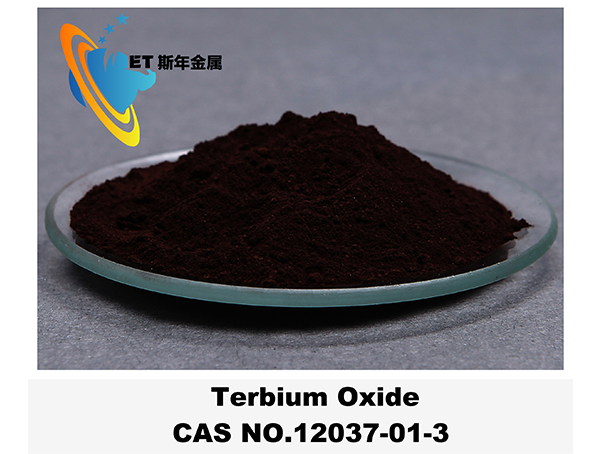
CAS #: 12037-01-3
Molecular Formula: Tb4O7
EC No.: 234-856-3


Terbium oxide is a Inorganic compound, chemical formula: Tb4O7, brown powder, density: 7.3g/cm3, melting point: 2500 ℃, boiling point: 3760 ℃. At 1800 ℃ and 15MPa pressure, Terbium(III) oxide can be obtained by hydrogen reduction and oxidation. It is insoluble in water and soluble in acid to form trivalent salts. It can be volatilized with steam, alkaline, toxic, irritating to eyes, respiratory tract and skin, and can absorb carbon dioxide in the air and generate water soluble salts with Mineral acid.
Applications:
1. Used as an activator for long afterglow phosphors
2. Used for growing TGG, TSAG crystals, etc
3. It can also be used as a special scintillation ceramic additive, etc
4. Used for the production of metal terbium.
| Product | Product Code | Security Data | Technical Data |
| Terbium Oxide 99.99% | ET-Tb-02 | ||
| Terbium Oxide 99.999% | ET-Tb-03 |
| Molecular Formula | O7Tb4 |
| Molecular Weight | 747.69 |
| Appearance | Brown powderBrown powder |
| Melting Point | N/A |
| Boiling Point | N/A |
| Density | 7.3 g/cm3 |
| Precise Quality | 747.66579 |
| Single Isotope Mass | 747.66579 |
| Signal Word | N/A |
| Risk Statement | N/A |
| Dangerous Code | N/A |
| Preventive Instructions | N/A |
| Flash Point | Not applicable |
| Risk Code | N/A |
| Safety Statement | N/A |
| RTECS Number | N/A |
| Transportation Information | NONH |
| WGK Germany | 3 |
Packaging Specifications:
Standard packaging: 50 kg/drum, 500 kg/pallet, ton bags
Sample packaging: 500 g/bag, 1 kg/bottle
| Terbium Oxide |

The production method of Terbium Oxide is mainly oxalic acid precipitation method, that is, taking Terbium(III) chloride or Terbium(III) nitrate solution as raw material, adjusting the Ph value to 2 with oxalic acid, adding ammonia to precipitate terbium oxalate, heating, curing, separation, washing, drying at 110 ℃, and burning at 900~1000 ℃ to form terbium oxide. |

Room 310, Building 1, No. 326, Jinyuan Third Road, Jiading District, Shanghai
Tel : +86-400-6632276
Mobile&Whatsapp : +86 19916550170
Email : sales@eternal-element.com
Scan to wechat :


