Hello!Welcome to Shanghai Sheeny Metal Materials Co.,Ltd. Website!
Hotline:+86-400-6632276

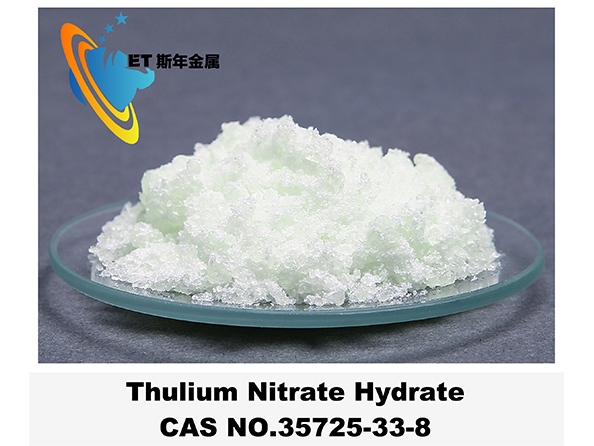
CAS # : 35725-33-8
Molecular formula: Tm(NO3)3 • 6H2O
EC No. : 239-069-9


Thulium nitrate is an inorganic compound with the chemical formula Tm(NO3)3 • 6H2O, and it is a light green crystal. It is soluble in water. At 18℃, about 25g of hydrate can be dissolved in 100mL of water. Soluble in benzene. Heated to 760℃, it decomposes into thulium oxide.
Applications:
1. Used as an additive in the chemical industry.
2.Used as a catalyst for various reactions.
3. Growth agents for crops。
Product | Product code | Security Data | Technical Data |
Thulium Nitrate Hydrate 99.99% | ET-TmN |
Molecular Formula | H12N3O15Tm |
Molecular Weight | 463.04 |
Appearance | Off-white to green crystalline granules |
Melting Point | N/A |
Boiling Point | 83°C |
Density | N/A |
Precise Quality | 462.961055 |
Single Isotope Mass | 462.961055 |
Signal Word | N/A |
Risk Statement | N/A |
Dangerous Code | N/A |
Transportation Information | N/A |
Packaging Specifications:
Standard packaging: 50 kg/drum, 500 kg/pallet, ton bags
Sample packaging: 500 g/bag, 1 kg/bottle
| Thulium Nitrate Hydrate |

Dissolve an appropriate amount of thulium oxide in a 50% nitric acid solution and heat it in a steam bath. Usually, thulium oxide can be completely dissolved. If there is a small amount of oxide remaining at the bottom of the container, it needs to be filtered. The obtained clear liquid was heated in a water bath at 75℃ to remove most of the solvent. Crystals precipitate when the solution cools. Filter the crystals, place them in a vacuum dryer containing granular sodium hydroxide and magnesium perchlorate, and dry them under vacuum to obtain thulium nitrate hydrate. |

Room 310, Building 1, No. 326, Jinyuan Third Road, Jiading District, Shanghai
Tel : +86-400-6632276
Mobile&Whatsapp : +86 19916550170
Email : sales@eternal-element.com
Scan to wechat :


