Hello!Welcome to Shanghai Sheeny Metal Materials Co.,Ltd. Website!
Hotline:+86-400-6632276

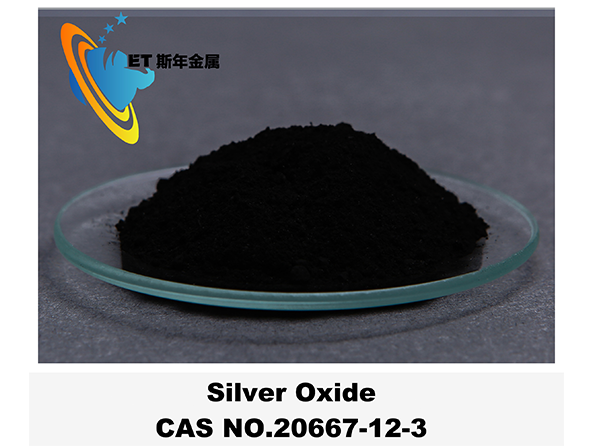
CAS #: 20667-12-3
Molecular Formula: Ag2O
EC No.: ET-Mg-01


Silver oxide, with the chemical formula Ag2O. Molecular weight: 231.74. Brownish-black cubic crystals or powder. It gradually decomposes into silver and oxygen when exposed to light. Specific gravity: 7.143(16.6℃). When dried between 60 and 80 degrees Celsius, it is nearly black. It decomposes when heated to 300 degrees Celsius, and its decomposition accelerates between 250 and 300 degrees Celsius. It is slightly soluble in water and shows an alkaline reaction, soluble in ammonia water, potassium cyanide solution, nitric acid and sodium thiosulfate solution, and slightly soluble in ethanol. Moist substances can absorb carbon dioxide from the air. When alkali is present, the aqueous solution of formaldehyde can reduce it to metallic silver. Friction with flammable organic substances can cause combustion. When its ammonia solution is left for a long time, it sometimes precipitates black crystals with strong explosive properties, which may be silver nitride Ag3N or silver imide Ag2NH. In organic synthesis, it is often used to displace halogen atoms with hydroxyl groups or as an oxidant. In the glass industry, it can also be used as a colorant. It is prepared by the reaction of silver nitrate solution with sodium hydroxide solution.
Applications:
1.Electrode materials for silver oxide batteries.
2. It is used to convert organic bromides and chlorides into alcohols, and to convert benzyl halides into benzyl ethers. When used in combination with methyl iodide, it serves as a methylation reagent.
3. For surface catalysts.
4. It is used for preparing water purifying agents.
Product | Product Code | Security Data | Technical Data |
| Silver Oxide 99.5% | ET-Ag-01 |
| Molecular Formula | Ag2O |
| Molecular Weight | 231.74 |
| Appearance | Brown Powder |
| Melting Point | 280° C (536° F) |
| Boiling Point | N/A |
| Density | 7220 kg/m-3 |
| Solubility In Water | N/A |
| Precise Quality | N/A |
| Single Isotope Mass | 229.805101 Da |
| Charge | N/A |
| Signal Word | Danger |
| Risk Statement | H271-H318-H410 |
| Dangerous Code | O,Xi |
| Preventive Instructions | P220-P273-P280-P305 + P351 + P338-P501 |
| Flash Point | Not applicable |
| Risk Code | 36/37/38 |
| Safety Statement | 17-26-36 |
| RTECS Number | VW4900000 |
| Transportation Information | UN1479 - class 5.1 - PG 1 - EHS - Oxidizing solid, n.o.s., HI: all |
| WGK Germany | 2 |
Packaging Specifications:
Standard packaging: 50 kg/drum, 500 kg/pallet, ton bags
Sample packaging: 500 g/bag, 1 kg/bottle
| Silver Oxide |

Silver oxide is the electrode material of silver oxide batteries. It is also a weak oxidant and weak base in organic synthesis. It can react with 1, 3-disubstituted imidazole salts and benzimidazole salts to form nitrogen heterocyclic carbenes, which can replace unstable ligands such as cycloocdiene or acetonitrile as carbene transfer reagents to synthesize transition metal carbene complexes. In addition, silver oxide Chemicalbook can convert organic bromomes and chlorides into alcohols at low temperatures and in the presence of water vapor, convert benzyl halides into benzyl ethers, be used in combination with methyl iodide as a methylation reagent in sugar methylation analysis and Hofmann's dissipation reactions, as well as oxidize aldehydes to carboxylic acids. It is also used as a surface catalyst in the epoxidation reaction of alkenes. Production method: The silver nitrate method involves the reaction of silver nitrate solution with sodium hydroxide solution. The resulting silver oxide is then washed, separated and dried to obtain the finished product. The reaction formula is: 2AgNO3+2NaOH→Ag2O+2NANO3+H2O |

Room 310, Building 1, No. 326, Jinyuan Third Road, Jiading District, Shanghai
Tel : +86-400-6632276
Mobile&Whatsapp : +86 19916550170
Email : sales@eternal-element.com
Scan to wechat :


